


Summary · Quick answer
Mercury in the 12th Bhava births a mind that thinks most clearly in solitude, finding its truest expression in the hidden and the contemplative.
This is editorial context. Where no primary citation is shown, treat it as a guide, not as a verified claim, personal prediction or medical advice.
Budha in the Vyaya Bhava: Intelligence Turned Inward
The 12th Bhava — known in classical Jyotish as Vyaya Bhava, the house of expenditure, dissolution, and the invisible — represents the domain where the ordinary rules of the manifest world thin and give way to something more subtle: the realm of the subconscious, of spiritual withdrawal, of what is hidden from public view, and when Budha, the planet of intellect, language, and discursive thought, takes up residence here, the native's mental life becomes extraordinarily rich in its interior dimensions even as it retreats from easy public display. This is the scholar whose most brilliant work happens in private, whose thinking deepens precisely in those hours of withdrawal from social contact that others might experience as loneliness but which this native recognises as Prana — the vital breath of the mind, without which all thought becomes thin and performative rather than genuine and penetrating. The paradox of this placement is that Budha, a planet of communication and exchange, must do its finest work in a Bhava that withdraws from the marketplace, and the resolution of this paradox is the native's recognition that the most profound communication — the kind that truly moves and transforms others — originates not in social fluency but in the depths of private contemplation where truth has the space to reveal itself without the pressure of an audience.
This plays out differently in every chart.
See it in yours →The Solitary Writer Whose Inner World Overflows onto the Page
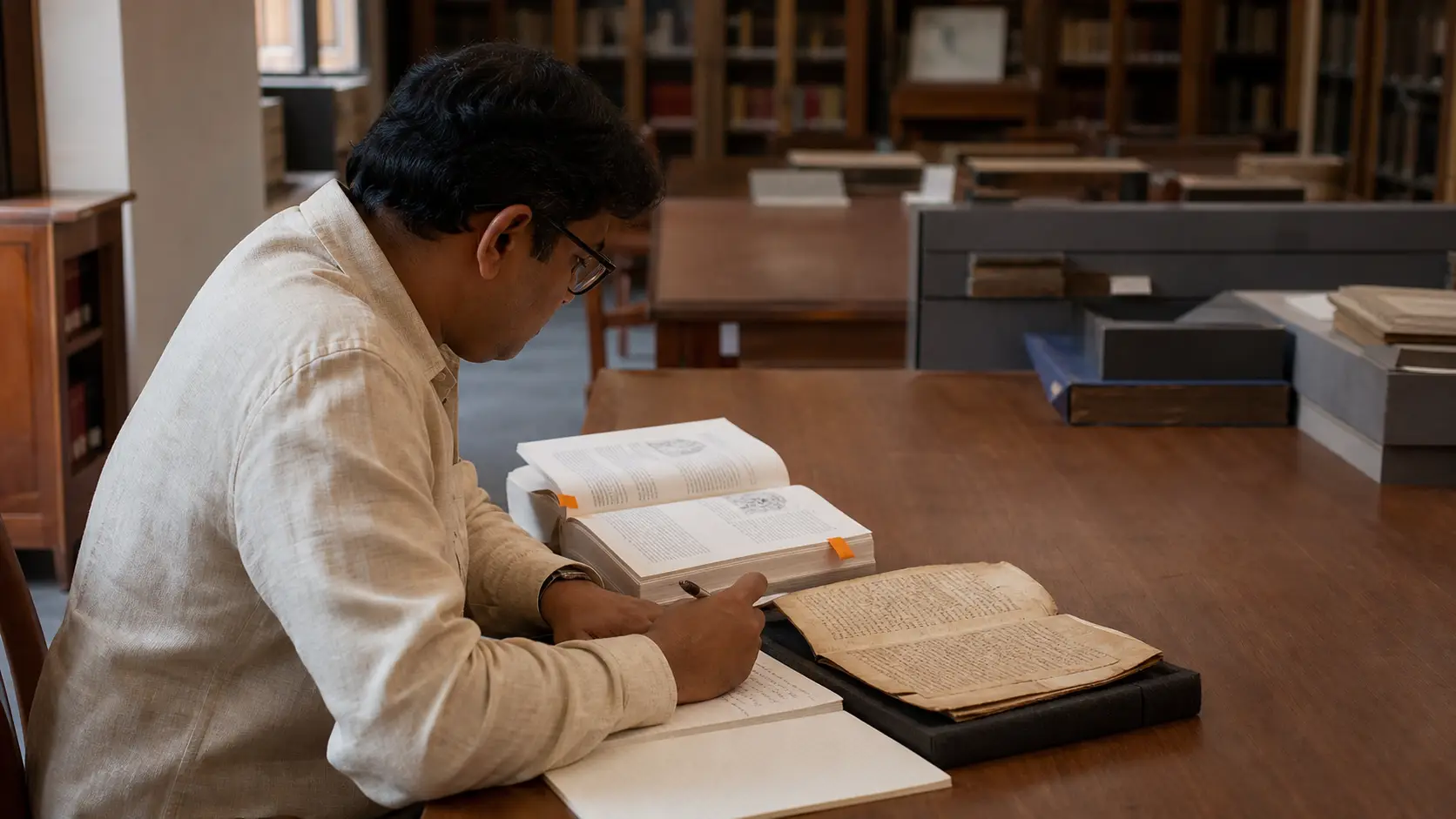
Budha in the 12th Bhava is the classical signature of the writer — not the journalist, the orator, or the public intellectual who thrives on live exchange, but the author who retreats to a quiet room, closes the door, and finds in solitude the conditions under which language becomes capable of carrying genuine weight and precision. The 12th house governs all forms of voluntary and involuntary seclusion: the retreat, the library, the monastery, the study, the long train journey through unfamiliar landscape — and in each of these environments, the Mercury in the 12th native discovers that their mind works differently than it does in company, that thoughts which seem elusive or scattered in conversation crystallise with startling clarity when the external noise drops below a certain threshold and the Manas is left alone with itself. The creative output of this placement is often marked by depth, interiority, and an unusual capacity for sustained attention on a single subject across months or years of patient work — qualities that produce literature, philosophy, and scholarship of lasting rather than momentary value, work that rewards re-reading because it was written by someone who thought about the same thing many times from many angles before committing a single sentence to the page.
Foreign Languages and Distant Cultures as Mercury's True Domain
In classical Jyotish, the 12th Bhava rules foreign lands, distant peoples, and all that exists beyond the borders of the native's origin — Videsha, the away-place, the elsewhere that both calls and challenges — and Budha's presence here creates a mind that is constitutionally drawn to the languages, literatures, and intellectual traditions of cultures other than the one into which the native was born, finding in the encounter with foreign systems of thought not disorientation but a peculiar homecoming, as if the native's intellect was designed for a wider world than the one immediately available. This placement consistently produces proficiency in multiple languages, often achieved through immersion rather than formal study, because the Mercury in the 12th native learns by absorption — soaking up vocabulary, syntax, and the subtle conceptual frameworks that different languages encode — and the resulting bilingual or multilingual capacity becomes not merely a professional skill but a cognitive gift, expanding the native's ability to think across categories that a monolingual mind cannot easily bridge. Translation, interpretation, foreign literature scholarship, cross-cultural consulting, and linguistics are natural vocations for this placement, fields where the native's unusual intimacy with the boundary between one linguistic world and another becomes a form of Karma-Dharma alignment: work that feels native to the soul's deepest inclinations.
Keep going
See this in your chartFree Kundli — planets, houses and yogas from your exact birth details
A Mind That Requires Solitude to Achieve Its Full Power
Among the most practically significant dimensions of Budha in the Vyaya Bhava is a cognitive style that fundamentally differs from the Mercurial norm: where most Mercury placements produce a mind that thinks by speaking — that articulates ideas into clarity through conversation, debate, and social processing — Mercury in the 12th produces a mind that thinks by withdrawing, one that needs time alone with a problem before it can produce anything worth saying, and one that feels the over-socialised, always-on rhythms of modern life as a subtle but persistent drain on the very Prana that the intellect requires to function at its best. This is not introversion in the popular psychological sense — a social preference — but something more specifically cognitive: an epistemological requirement for quiet, for the absence of interruption, for the particular quality of attention that arises only when the mind is not performing for an audience but genuinely engaged with the substance of a question for its own sake. The Vedic concept of Viveka — the discriminating intelligence that separates the real from the apparent, the essential from the contingent — is cultivated most naturally in conditions of solitude, and this native's life wisdom often includes the hard-won understanding that protecting their alonetime is not selfishness but the most important form of self-knowledge: the act of providing the conditions under which their distinctive mind can deliver what it alone is capable of delivering.
Dhyana, Contemplation, and the Sacred Approach to Knowledge
At its most elevated expression, Budha in the 12th Bhava produces a mind that approaches knowledge not merely as a tool for navigating worldly life but as a spiritual practice — a form of Dhyana, of meditative inquiry — in which the act of thinking deeply about something true becomes inseparable from the act of touching the Atman, the self beneath the self that in Hindu philosophy is the ground of all genuine knowing. The 12th house is the house of Moksha in its preparatory aspect — not liberation itself but the loosening of the grip that external things have on consciousness — and Mercury here learns, often through experiences of isolation, loss, or voluntary retreat, that the intellect's highest function is not to accumulate or compete but to penetrate: to go through the surface of phenomena into their underlying nature, to sit with a question long enough that it dissolves into something more fundamental than an answer. Many natives of this placement are drawn to mantra, to philosophical study in the traditions of Advaita Vedanta, Yoga, or Buddhist contemplation, to any practice that uses language — sacred language, precise language, language stripped of ornament and pointed directly at reality — as a vehicle for transcendence rather than merely communication, discovering in this convergence of Budha and the 12th Bhava's renunciatory energy the most personally authentic expression of their Dharma.