


Summary · Quick answer
Mercury in the 4th Bhava builds a life where intellect and home are inseparable — the mind turns inward, and the house becomes both sanctuary and study.
This is editorial context. Where no primary citation is shown, treat it as a guide, not as a verified claim, personal prediction or medical advice.
A Childhood Home Where Books Replaced Ordinary Toys
Mercury placed in the Chaturthi Bhava — the fourth house of home, roots, mother, and inner emotional life — creates a childhood environment saturated with intellectual stimulation, a domestic space where bookshelves line every wall, where conversations at the dinner table range from history and philosophy to current events and verbal wordplay, and where the child's developing Manas is shaped not primarily by physical comfort or emotional warmth but by the constant hum of ideas circulating through every room. The native's earliest memories are organized around learning: the encyclopedia consulted after a question was asked, the newspaper that arrived each morning and was thoroughly discussed, the educational programs watched with genuine engagement rather than passive entertainment, the neighborhood school that felt like an extension of home because both operated on the same intellectual currency. In classical Jyotish, the fourth house represents Sukha — contentment and inner happiness — and for these natives, Sukha is irreducibly cognitive in nature; they are most content, most at ease, most themselves when their mind is actively engaged, and their earliest home environment installed this equation between mental activity and well-being so deeply that it operates as an unconscious template for every living situation they create throughout their adult life.
This plays out differently in every chart.
See it in yours →A Mother Whose Mercury Qualities Shaped Every Conversation
The fourth house in Jyotish is fundamentally the house of Matru — the mother — and Mercury placed here gives the native a mother who embodies Mercurial qualities with particular clarity: she is witty, verbally expressive, intellectually curious, often formally educated or self-educated with the voraciousness that compensates for formal instruction, and she communicates with her child as though the child were a capable interlocutor from a very early age rather than a dependent who must wait for adult comprehension to develop. This mother asks questions and expects considered answers; she corrects grammar and celebrates vocabulary; she reads aloud and discusses what was read; she models the Vedic concept of Viveka — discriminative intelligence — in her daily decision-making in ways that the child absorbs without consciously recognizing the transmission. Her Mercury qualities may manifest in professional life as a teacher, writer, journalist, accountant, lawyer, or any field where the precision and agility of language and analysis are primary tools, and she carries these professional qualities into her maternal role with an insistence that intellectual development is as fundamental a form of nourishment as food. The native's relationship with her is characterized by exceptional mutual understanding across verbal and written exchange, and some of the most formative emotional transactions between mother and child in this placement occur through letters, written notes, or the particular intimacy of reading the same book and comparing interpretations.
Analyzing Emotion Rather Than Simply Living Inside It
One of the most psychologically significant signatures of Mercury in the Chaturthi Bhava is the native's characteristic tendency to process emotional experience through the instrument of analytical thought rather than allowing feeling to exist on its own terms — a tendency that produces extraordinary self-awareness and psychological insight at the same time that it creates a subtle but persistent distance between the native and the direct somatic experience of their own inner life. When grief arrives, these individuals write about it; when love deepens, they map its stages; when anxiety surfaces, they diagram its triggers; and while this capacity for emotional intelligence is genuinely valuable and often makes these natives deeply perceptive counselors and emotionally articulate partners, it also means that the Manas sometimes interposes itself between the Atman and the raw experience of feeling in ways that leave certain emotional depths unexcavated. The Vedic tradition recognizes this as a particular karmic challenge of Mercury's placement in water-influenced houses: Budha's essential nature is airy and analytical, and the fourth house's deeper emotional waters require the native to consciously develop what ancient texts call Bhavana — the capacity to rest in feeling without immediately converting it into thought. Meditation practices that emphasize the witness-consciousness quality of Samkhya philosophy are particularly suited to this placement, offering a way to observe inner life that does not require converting emotion into intellectual data.
Keep going
See this in your chartFree Kundli — planets, houses and yogas from your exact birth details
The Home Becomes Study, Office, and Inner Sanctum of the Mind
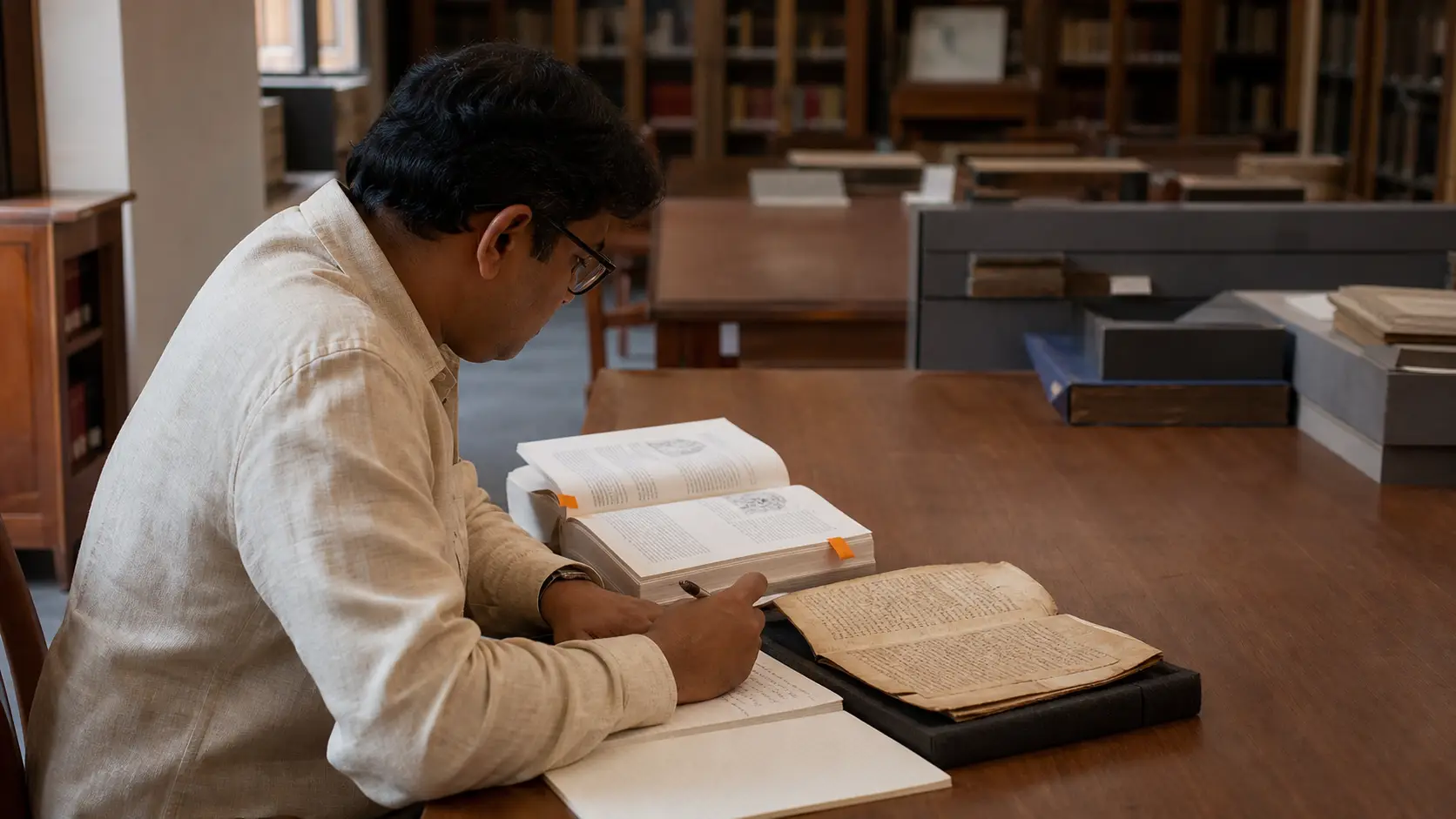
Mercury in the fourth house produces adults who organize their domestic space around intellectual function with an insistence that reveals the deep identification between home and mind that characterizes this placement — their living environment is invariably filled with books, journals, reference materials, instruments of writing and research, and increasingly in the contemporary context, the technological infrastructure that connects them to global networks of information from within the boundary of the home. Remote work and home-based intellectual careers suit these natives with unusual precision because the fourth house is where they feel most cognitively alive, and the intrusion of external office environments with their social demands and spatial inflexibility constitutes a genuine reduction of their productive capacity rather than a neutral change of location. In traditional Jyotish, the fourth house represents the inner chamber — the Antahkarana — and Mercury here makes this inner chamber into a place of perpetual intellectual activity, a library of accumulated learning that the native returns to again and again as the source of both professional output and personal restoration. The study or library they create within their home is not merely a practical workspace but a deeply personal sacred space, a Kshetra of the intellect where they perform the daily sadhana of thinking, writing, and organizing the material of their understanding into structures that can be shared with the outer world.
Property Investment Through the Lens of Pure Calculation
The fourth house rules immovable property — Sthavar Sampatti — and Mercury positioned here gives natives an intellectual rather than emotional or security-driven relationship to real estate, so that where most people approach the question of home purchase through the filters of comfort, family tradition, neighborhood feeling, and long-term settlement instinct, these individuals approach it as an analytical problem to be solved through data: comparable sales analysis, structural assessment, yield calculations, development potential modeling, and the kind of systematic due diligence that converts an inherently emotional transaction into something closer to a mathematical exercise. This approach produces investors who are less susceptible to the irrational enthusiasm that drives property bubbles and more capable of identifying value in locations and property types that have not yet attracted the herd's attention, because their assessment rests on information rather than impression. However, the same Mercury quality that makes them astute analysts also creates a tendency toward excessive deliberation, a paralysis of options where the perpetual gathering of additional data substitutes for the final committed decision that property acquisition ultimately requires. The Bhagya of these natives in property matters is best expressed when they learn to trust the conclusions that their analysis actually delivers rather than perpetually reopening the investigation, recognizing that the gift of Budha in the fourth house is precisely the capacity to see what others miss — and that this capacity is defeated when the seeing is never followed by acting.