


Summary · Quick answer
Mercury in the 9th Bhava forges a razor-sharp philosophical intellect that demands evidence before accepting any doctrine.
This is editorial context. Where no primary citation is shown, treat it as a guide, not as a verified claim, personal prediction or medical advice.
When Logic Becomes the Path to Higher Truth
In Vedic Jyotisha, the 9th Bhava is the seat of Dharma, Bhagya, and the higher Manas — the faculty of mind that reaches beyond sensory experience toward universal principle — and when Budha, the planet of discrimination and rational inquiry, occupies this sacred house, the native approaches all philosophical and religious truth not through faith alone but through the rigorous application of intellectual examination, demanding that every doctrine, every scripture, and every guru's pronouncement survive the test of logical scrutiny before earning the conviction of the Atman. This placement produces what the classical texts recognise as the Jijnasu temperament — the true seeker — who cannot simply accept inherited belief but must dismantle, reassemble, and verify every tenet of Dharma through direct reasoning, comparative study, and lived experiential cross-reference. The result is a philosophical outlook of extraordinary precision: these natives articulate the deepest metaphysical principles of Vedanta, Sankhya, or Nyaya with the same clarity a mathematician brings to a proof, transforming abstract Karma doctrine into something teachable, transmissible, and practically actionable for ordinary minds.
This plays out differently in every chart.
See it in yours →Higher Education Pursued with Relentless Intellectual Hunger
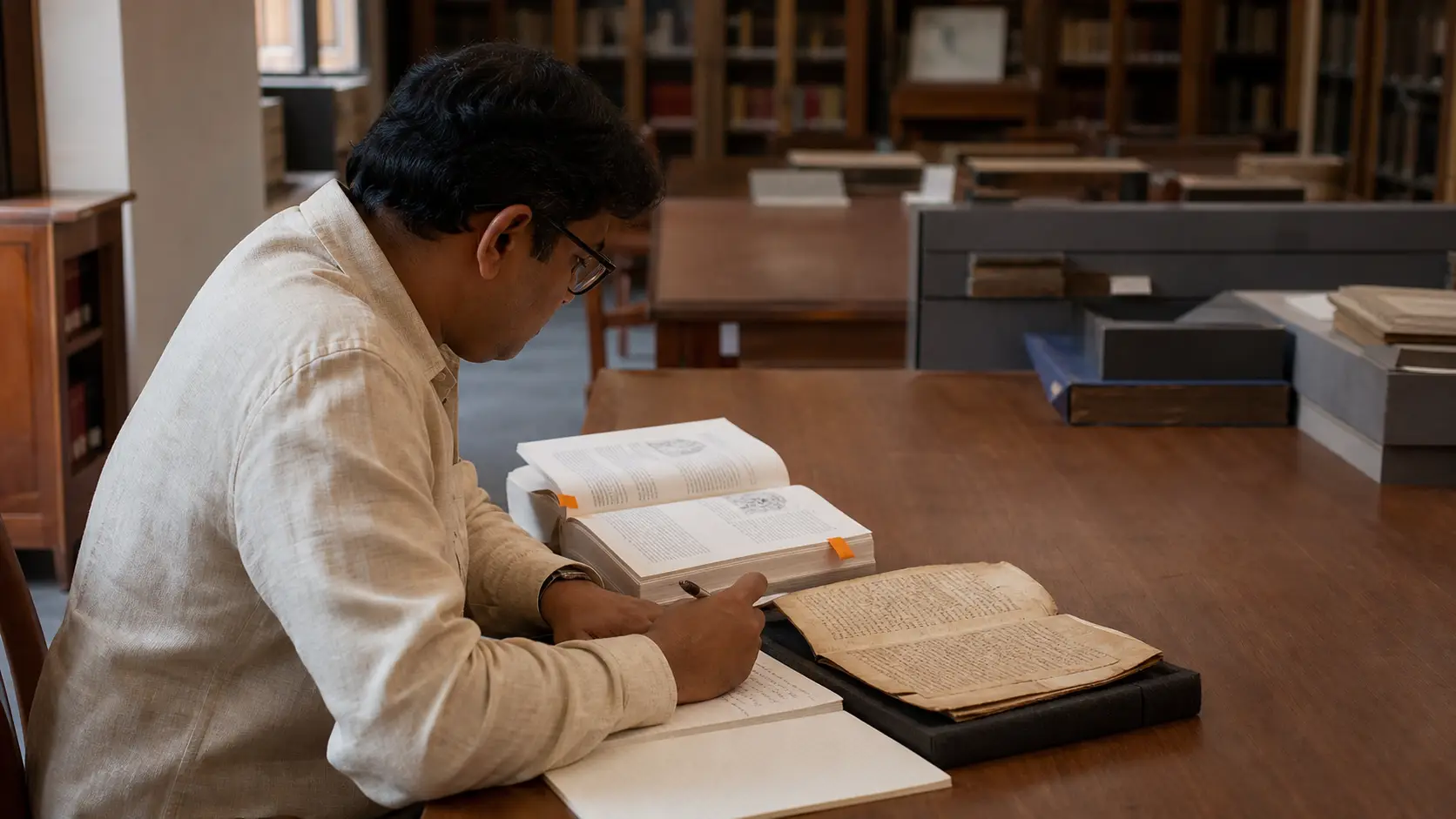
Budha ruling the 9th Bhava creates an insatiable appetite for formal higher learning that typically extends far beyond a single degree, a single discipline, or a single institution — these natives accumulate credentials across philosophy, linguistics, law, theology, and the sciences because each new domain of knowledge becomes a lens through which they refine and stress-test their evolving worldview. Universities, seminaries, research institutes, and centres of advanced study become the native's natural habitat, and the role of teacher or professor emerges not merely as a profession but as a Dharmic calling, a fulfilment of the soul's mandate to synthesise vast learning into transmissible wisdom. The 9th Bhava's connection to Guru and sacred teaching means that Mercury here produces instructors of remarkable pedagogical skill — individuals who break down the most abstruse philosophical system into step-by-step intellectual progressions that illuminate understanding rather than merely transferring information, and this gift for structured exposition of complex Jnana makes them sought after as lecturers, academic authors, and institutional architects of curriculum across every level of formal Vidya.
Cross-Cultural Communication as a Spiritual Instrument
The 9th Bhava governs long-distance travel, foreign lands, and contact with cultures distant from the native's own birth environment, and Budha here transforms this cross-cultural encounter into an instrument of intellectual and spiritual expansion — these natives acquire foreign languages with unusual ease, absorb the philosophical frameworks of distant traditions with genuine depth rather than superficial curiosity, and move between cultural registers with the linguistic fluency of someone who intuitively grasps that every civilisation has developed a unique vocabulary for describing the same underlying universal Dharma. Where lesser minds see contradiction between, say, Advaita Vedanta and Platonic philosophy or between Buddhist Pratītyasamutpāda and Stoic logos, the Mercury-in-9th native sees family resemblance — structural correspondences that reveal the common ground beneath different linguistic and cultural surfaces — and this cross-cultural Prajna becomes itself a form of spiritual service, as the native acts as a living bridge between wisdom traditions, translating insights across linguistic and doctrinal boundaries so that the essential Satya of each tradition becomes accessible to seekers who would otherwise never encounter it.
Keep going
See this in your chartFree Kundli — planets, houses and yogas from your exact birth details
Publishing and Writing as Acts of Philosophical Transmission
Budha is the karaka of writing, publishing, and the dissemination of ideas through text, and when positioned in the 9th Bhava — the house of Guru, Shastra, and sacred knowledge — this mercurial energy finds its highest expression in the composition and publication of philosophical, educational, and theological literature that reaches audiences far beyond the spoken word's natural limits in time and geography. These natives produce books, essays, commentaries, and educational frameworks of lasting value — texts that synthesise wide reading with original insight and communicate abstract truth in prose of unusual clarity and intellectual elegance, texts that serve as what the tradition calls Shabda Pramana, valid verbal testimony through which knowledge legitimately propagates from one Manas to another across generations. The act of writing is experienced not as mere professional output but as a Yajna — a sacred ritual of offering — in which the native distils years of study, travel, and philosophical encounter into a form that other seekers can use as a lantern on their own path toward Moksha, and this sense of sacred responsibility imbues every sentence with a weight and precision that casual writing never achieves.
The Father and Guru Relationship: Shaped Through Dialogue
In classical Parashari Jyotisha, the 9th Bhava is simultaneously the house of Pitru — the father — and the Guru, and Budha's placement here gives the father-child and student-teacher relationships a distinctively intellectual character: the father in these natives' lives is formative not through emotional warmth or physical provision alone but through intellectual stimulation — books given, debates initiated, questions posed that had no easy answers — so that the father functions simultaneously as the first Guru, the one who awakened the native's hunger for knowledge and instilled the habit of questioning received wisdom before accepting it as truth. This father-as-intellectual-mentor archetype means the native carries an internalised dialogic voice — the habit of testing every idea against an imagined interlocutor's objection — that continues operating long after the literal father's direct influence recedes, becoming the engine of the native's own philosophical rigour throughout life. The Guru relationships formed in later life follow the same pattern: the native gravitates toward teachers who engage in Socratic exchange rather than mere pronouncement, who welcome the student's questions as evidence of genuine Jijnasa rather than impertinence, and who treat the relationship between Guru and Shishya as a living dialogue between two minds moving together toward greater Prajna.