

Summary · Quick answer
When the Moon occupies the 9th Bhava, dharma becomes a felt experience of the heart, not merely a philosophy of the mind.
This is editorial context. Where no primary citation is shown, treat it as a guide, not as a verified claim, personal prediction or medical advice.
Emotional Hunger for Dharma and Spiritual Meaning
In Vedic Jyotisha, the 9th Bhava governs Dharma, Bhagya, and the higher philosophical framework through which a soul understands its place in the cosmos, and when Chandra — the Karaka of the Manas, the emotional mind, and the deepest instinctual needs — takes residence here, the native does not merely contemplate spiritual truths but feels them as visceral necessities, as essential to wellbeing as water is to the physical body. This is a native whose entire emotional constitution is oriented toward meaning: the absence of a coherent spiritual worldview produces genuine psychological suffering, a restlessness of the Manas that no material comfort can resolve, while the presence of a living, breathing faith produces a groundedness and inner nourishment that sustains through every hardship. The Moon here does not merely seek religion as a Sunday ritual or a philosophical exercise; it seeks darshan — the direct emotional experience of the sacred — and without that felt connection to something greater than the individual Atman, this person moves through life with a sense of incompleteness that manifests as emotional seeking, often across multiple traditions, teachers, and sacred texts, until the heart finds its true spiritual home.
This plays out differently in every chart.
See it in yours →A Worldview Felt in the Bones, Not the Books
Where other placements might produce scholars who study dharmic texts with admirable detachment, the Moon in the 9th Bhava produces a native whose philosophical worldview is inseparable from emotional experience — every belief is felt before it is reasoned, every principle is absorbed through the heart before it is articulated by the intellect, and this gives their understanding of Vedanta, of karma, of the great cosmic order an authenticity and warmth that purely intellectual approaches cannot replicate. These natives absorb the essence of a teaching at the level of Prana rather than at the level of the rational Buddhi, which means their wisdom carries a living quality, an intuitive rightness, that resonates deeply with others seeking not just information but genuine spiritual sustenance. The 9th Bhava also governs Guru and the principle of teaching, and with Chandra here the native often becomes a natural guide for others on the spiritual path, not through academic authority but through the emotional credibility that comes from having genuinely lived and suffered and rejoiced through their beliefs — their philosophy is autobiography as much as theology, and others feel this truth in every word they speak on matters of dharma and the higher purpose of human life.
The Mother as Guru and Sacred Guide
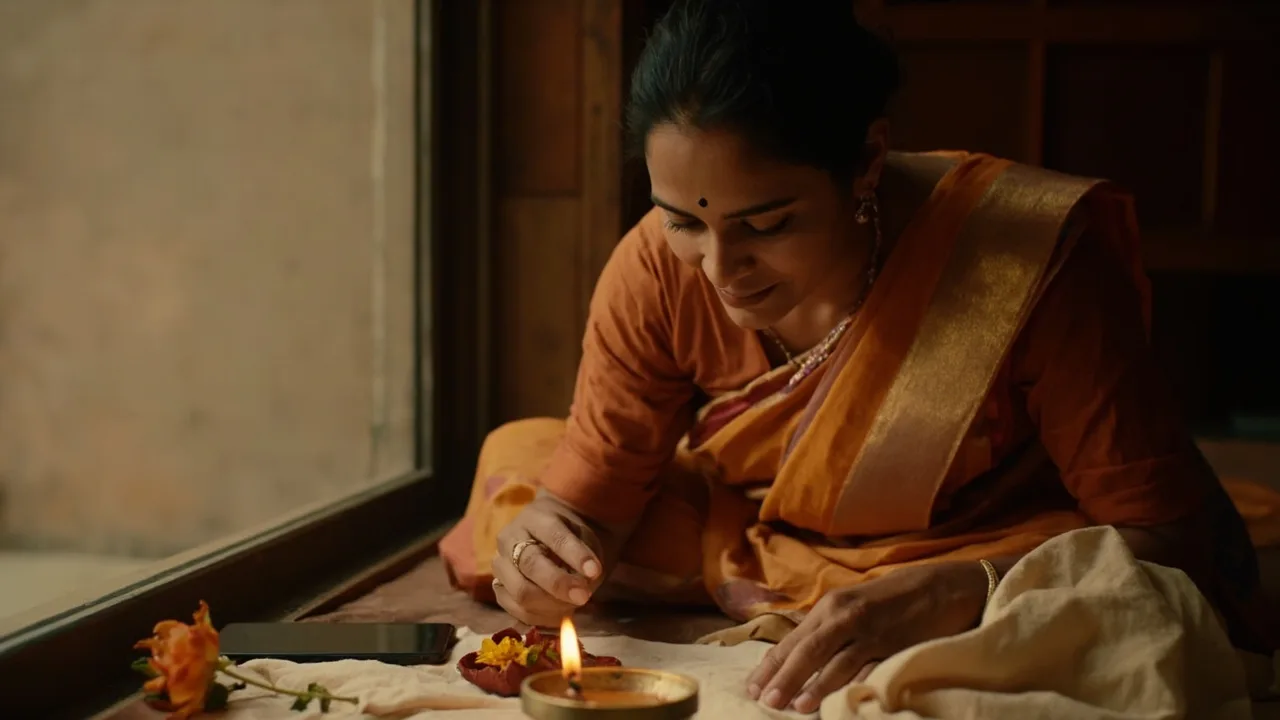
Chandra is the supreme Karaka of the mother in Jyotisha, and its placement in the 9th Bhava — the house of the Guru, of higher wisdom, of the spiritual path — creates a profound and defining synthesis: the mother herself becomes the native's first and most formative spiritual teacher, the one who instills not merely religious habits but a living relationship with the divine, shaping the emotional architecture of the native's entire philosophical worldview before any formal education begins. This mother is often herself a deeply religious or spiritually oriented woman, someone who prays with genuine feeling, who speaks of God or the divine order not as abstract doctrine but as intimate personal relationship, who carries her faith in her body and expresses it in every act of daily worship, of kitchen ritual, of lullaby and blessing — and all of this enters the native's Manas as the most natural thing in the world, becoming the emotional baseline against which all subsequent spiritual experience is measured. Even in adult life, when this native faces great philosophical questions or spiritual crossroads, the emotional memory of the mother — her certainty, her faith, her devotion — surfaces as an internal compass, and the native's entire relationship with Bhagya, with fortune and divine grace, is colored by the quality of that foundational maternal spiritual bond.
Keep going
See this in your chartFree Kundli — planets, houses and yogas from your exact birth details
Pilgrimage and Sacred Travel as Emotional Nourishment
The 9th Bhava governs long-distance journeys and pilgrimage — Tirtha Yatra — and when Chandra occupies this house of sacred travel, the act of visiting holy sites, of walking barefoot on temple stone, of bathing in sacred rivers, of sitting in the presence of great saints or in the stillness of an ancient mandir, becomes an experience of profound emotional restoration, a genuine coming-home for the Manas that no other form of travel can replicate. These natives do not travel to temples the way tourists visit monuments; they travel as pilgrims in the truest sense, carrying emotional longings and placing them before the divine with the same need and sincerity with which a child places its sorrows before a parent, and they return from such journeys genuinely nourished, calmer in spirit, clearer in purpose, as if some deep cellular thirst has been temporarily satisfied. Foreign lands and cultures that carry spiritual depth — India's tirtha-kshetras, ancient sacred sites across Asia, the great ashrams and temples of tradition — draw them with an emotional magnetism that is difficult to rationalize but impossible to ignore, and the native often discovers through sacred travel that the deepest home the soul possesses is not a house or a city but a state of devotional attunement that certain sacred spaces make available with extraordinary immediacy.
Fortune Flowing Through Dharmic Emotional Alignment
The 9th Bhava is Bhagya Sthana, the house of fortune, grace, and the accumulated Punya — merit — of past lives, and with Chandra placed here, the native's material and worldly fortune moves in direct correspondence with their emotional alignment to dharmic purpose, flowing abundantly when they live in genuine accord with their deeper spiritual values and contracting perceptibly when they drift into purely materialistic or emotionally disconnected modes of living. This is not a placement that supports the pursuit of success through purely strategic, ambitious means — those paths produce results that feel hollow and are frequently unstable; instead, fortune arrives through channels that carry emotional and spiritual resonance: through work that feels like seva, through relationships built on genuine care and mutual upliftment, through acts of generosity and teaching and wisdom-sharing that arise from authentic inner overflow rather than calculated giving. The fluctuating nature of Chandra means that fortune is not experienced as a steady, predictable stream but rather as tides — periods of extraordinary grace and abundance alternate with quieter intervals of inward consolidation — and the native who understands this rhythm learns to trust the ebb as preparation for the next flood of Bhagya, cultivating during the quiet periods the devotion and dharmic clarity that ensures the returning tide brings even greater blessings than the one before.