
Summary · Quick answer
Venus in the 12th Bhava conceals love in sacred solitude, foreign lands, and spiritual devotion, revealing that the deepest beauty is found beyond the veil of the visible world.
This is editorial context. Where no primary citation is shown, treat it as a guide, not as a verified claim, personal prediction or medical advice.
Secret and Hidden Romantic Relationships That Defy Convention
Shukra in the twelfth Bhava — the house of Viyoga, separation, hidden spaces, and all that withdraws from public view — creates a native whose romantic life unfolds largely outside the gaze of ordinary social visibility, producing relationships that are kept private by choice or circumstance, that operate under the protective shadow of secrecy, and that carry the peculiar intensity of love that cannot or does not announce itself openly to the world, finding its depth partly in the privacy that protects it from the diluting effects of social performance. The twelfth house governs what is concealed, what lies beyond the ordinary threshold of perception, and what requires withdrawal for its survival, and Shukra here does not produce the openly courting lover of the seventh house or the socially abundant romance of the eleventh but rather the devotee of hidden Prema — the person who loves most fully in private, whose most intimate and defining romantic experiences are known only to the beloved and perhaps to a very small circle of trusted confidants who understand the necessity of discretion. This pattern of hidden love arises for multiple reasons in different individual lives — social, cultural, or family constraints that prevent open acknowledgement; the natural introversion of a native who experiences genuine intimacy as possible only in private; the specific circumstance of a beloved who is unavailable by conventional social standards; or simply the native's deep intuition that love, like sacred ritual, is most potent when protected from the trivialising effects of public exposure — and in all these cases, the twelfth-house Shukra produces romantic experiences of unusual depth and spiritual resonance precisely because they occur in the protected inner sanctum of privacy.
This plays out differently in every chart.
See it in yours →Devotional Prayer as the Purest Expression of Venus's Grace
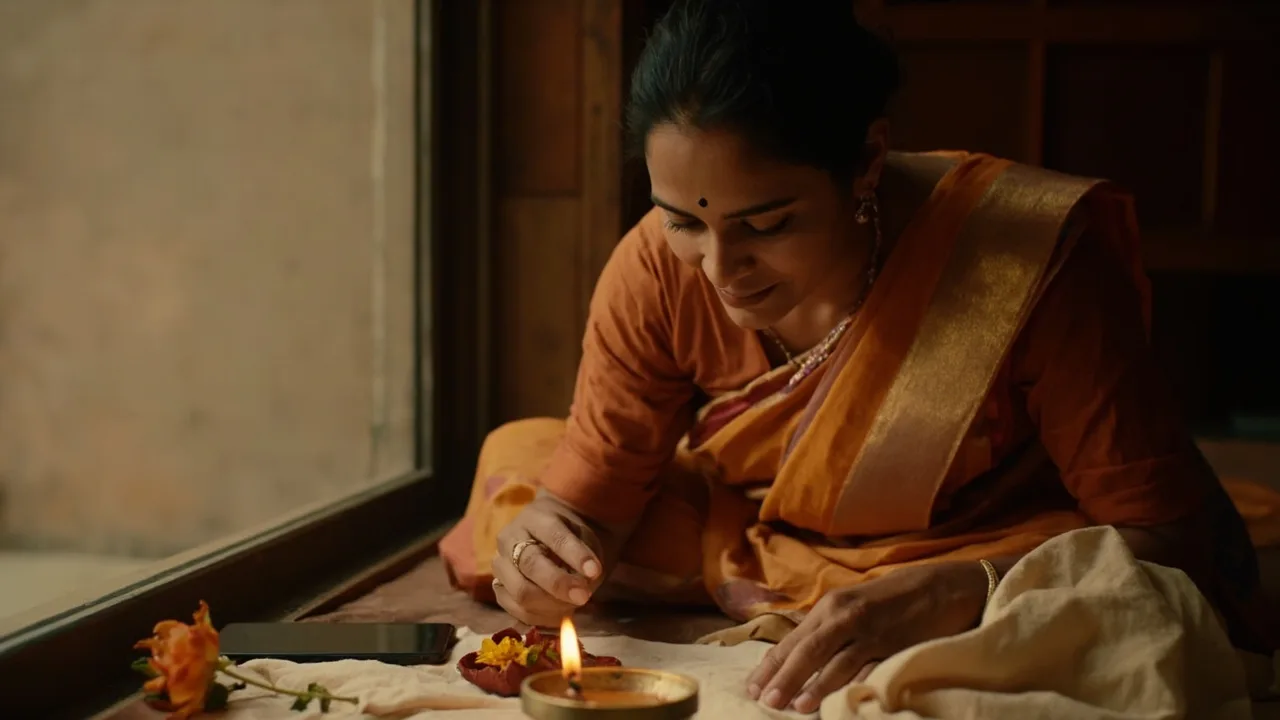
Shukra in the twelfth Bhava finds its most elevated and spiritually pure expression in the domain of Bhakti — devotional worship, prayerful surrender to the divine, and the practice of sacred beauty as a form of Upasana that transforms ordinary aesthetic experience into an avenue of union with the Paramatman. The twelfth house governs Moksha, Vairagya, and the dissolution of ego-boundaries that constitutes spiritual liberation in the Vedantic understanding, and a benefic Shukra here ensures that this dissolution is experienced not as loss or deprivation but as a kind of ecstatic release into beauty — the native discovering in deep prayer, in temple ritual, in the chanting of Lalita Sahasranama or Devi Mahatmyam, in the sensory richness of Puja with flowers and incense and ghee lamps, the same quality of transported delight that less spiritually oriented Venus placements find in romantic encounter or artistic experience. The goddess traditions of Hinduism — the Shakta worship of Devi in her thousand forms, the Vaishnava Bhakti of Radha-Krishna which understands romantic longing as a metaphor for the soul's desire for God — find their most natural devotional practitioner in the native with Shukra in the twelfth house, for whom the line between sacred and erotic love becomes increasingly transparent over time, revealing that both are expressions of the same primordial Iccha that moves through all creation toward its own source.
Sensory Retreat and the Profound Pleasure of Sacred Solitude
The twelfth Bhava governs Shayan — the bed, rest, retreat, and the regenerative withdrawal from active life into restorative solitude — and Shukra here creates a native who finds genuine, deep, and sustaining pleasure in the experience of being alone with beauty, in the crafted luxury of private retreat, in the deliberate creation of sensory environments so refined and pleasurable that withdrawal into them becomes a form of Yoga rather than mere escapism or avoidance of social obligation. The native's private spaces — bedroom, meditation room, personal sanctuary — are invariably among the most beautiful environments they inhabit, lavished with Venusian attentions that might seem excessive by conventional standards but are actually expressions of a spiritual understanding that the senses, when given the highest quality of nourishment in a context of intentional awareness, become instruments of transcendence rather than merely of worldly pleasure. In the Yoga tradition, Pratyahara — the withdrawal of the senses from external objects as a preparation for deeper meditative states — is understood not as sensory deprivation but as the purification of sense-faculty so that it becomes capable of perceiving subtler and more beautiful realities, and this is precisely what the twelfth-house Shukra native practices naturally — retreating into beautiful solitude not to escape the world but to realign their perceptual instrument with the finest frequencies of beauty that the world, experienced from within rather than from outside, continuously reveals.
Keep going
See this in your chartFree Kundli — planets, houses and yogas from your exact birth details
Foreign Lands and International Partners Carry Venusian Blessings
The twelfth Bhava in classical Jyotish governs Videsha — foreign lands, distant journeys, residence abroad, and all encounters with what lies beyond the familiar cultural and geographical horizon — and Shukra here creates a distinctive and often life-changing pattern in which the most significant, beautiful, and romantically transformative encounters occur in foreign contexts, with partners from different cultural or national backgrounds, or in the liminal spaces of travel and sojourn where ordinary social identity is temporarily suspended and genuine encounter becomes possible. The native characteristically finds that journeys abroad open into unexpected romantic or deeply meaningful aesthetic encounters, that the beauty of unfamiliar cultures — their music, visual arts, culinary traditions, architectural expressions, and the distinctive aesthetic philosophies embodied in their design and ritual life — acts as a profound Venusian stimulus that inspires creative work, romantic feeling, and a deepening of the native's understanding of beauty's universality across cultural difference. Foreign partners bring not only personal love but entire aesthetic worlds — different traditions of music, food, dress, domestic arrangement, and relational culture — that expand the native's Venusian sensibility in ways that stay-at-home experience cannot provide, so that the beloved from abroad becomes simultaneously a romantic partner and a cultural educator, a living bridge between aesthetic traditions that the native synthesises into something uniquely their own, carrying the Venusian gifts of their foreign encounters as permanent enrichments of their creative and relational life.
Luxury Expenditure and Beauty Spending Managed With Conscious Wisdom
The twelfth house governs Vyaya — expenditure, loss, and the outflow of resources — and Shukra's placement here creates a native with an instinctive and at times unchecked tendency to spend generously on the pleasures associated with Shukra's domain: fine fragrances, beautiful clothing, luxurious bedding, aesthetically refined environments, costly beauty treatments, fine dining, art acquisition, music, and all the sensory pleasures that Venus governs in both the material and subtler dimensions of human experience. The classical teaching is unambiguous — Shukra in the twelfth produces Bhoga (sensory enjoyment) through spending, and the native genuinely receives value from these expenditures in the form of authentic pleasure, restored vitality, creative inspiration, and the psychological wellbeing that comes from inhabiting environments of beauty — yet the challenge lies in maintaining awareness of the outflow so that Bhoga does not tip into unsustainable depletion of material resources. The Vedic wisdom for this placement is not renunciation — which would be spiritually incoherent for a twelfth-house placement in which Vairagya arises naturally through the spiritual path rather than through forced austerity — but rather conscious Viveka, the discriminating intelligence that distinguishes between expenditures that genuinely serve the soul's Venusian growth and those that are driven by the compensatory patterns of a Manas seeking beauty as an escape from unacknowledged spiritual longing, so that the native learns over time to satisfy Venus in the twelfth through the highest and most lasting expressions of beauty — devotional practice, genuine creative work, and the cultivation of inner stillness — rather than through endless material acquisition.