
Summary · Quick answer
The Mukha Dwara is the dwelling's first energetic contact. Learn which door directions attract Lakshmi and which invite Dosha.
This is editorial context. Where no primary citation is shown, treat it as a guide, not as a verified claim, personal prediction or medical advice.
Mukha Dwara in Manasara and Mayamata Classical Textual Foundations
The main entrance — Mukha Dwara or Simha Dwara — is the primary gateway through which cosmic prana enters the dwelling. Both the Manasara and the Mayamata dedicate substantial chapters to the entrance: Manasara Chapter 14 specifies the number of doors permissible on each wall, their width-to-height ratio, their threshold construction, and the sacred wood species to be used. Mayamata Chapter 13 classifies door types by their Pada position within the Vastu Mandala and correlates each position with specific outcomes for the household. The Vishwakarma Prakash elaborates on threshold deities — Dvarapalas — flanking the entrance and their proper installation. The Panchabhutas framework underlying entrance science is direct: the Mukha Dwara determines how the five elements flow into the interior space. An East-facing entrance welcomes Surya prana — solar Agni and Akasha — and the Vayu that carries it inward with each opening. A North-facing entrance channels Kubera's wealth energy and the Jala-Prithvi axis. The classical texts treat the entrance as more than architectural: it is a Yantra, an energy-directing instrument that must be correctly oriented, proportioned, and consecrated to function as a conduit for Shri — divine auspiciousness. Getting this element wrong is described in the Manasara as the single most impactful Vastu decision a householder makes.
This plays out differently in every chart.
See it in yours →Ashtadisha Rules — Which Direction, Which Pada, Which Deity Governs Entry
The Mayamata classifies the Vastu Mandala's outer Padas into named zones of auspiciousness for door placement. On the East wall, Padas named Jayanta, Indra, and Surya are highly favorable — Indra Pada placement for the main door is considered the gold standard by most classical commentators. On the North wall, Mukhya and Bhallata Padas are auspicious, aligning with Kubera's energy stream. The South and West walls are governed by Yama and Varuna respectively; doors here require additional Upayas. The Southwest under Nirrti is classified as Ashubha — inauspicious — for main entrances in every major text. Specific rules from Manasara: the door frame must be taller than wide in a ratio between 2:1 and 2.5:1 (Dvaradanda Niyama). The threshold — Dehliz — must be made of Prithvi-aligned wood such as teak or neem. The door must open inward and clockwise. The number of steps at the entrance must be odd — Visama Sanka — traditionally 3, 5, 7, or 9. The entrance must not directly face a T-junction, wall corner, or descending staircase, as these create Veedhi Shula — road arrow Dosha — directing negative Vayu into the home. Ashtadisha deity invocations are prescribed for each direction before door installation.
Entrance Doshas — Blocked Prana, Veedhi Shula, and Door Misalignment Effects
Several categories of Vastu Dosha are associated specifically with the Mukha Dwara. Veedhi Shula — literally 'road spear' — occurs when the main entrance directly faces a T-junction, a sharp wall corner, or a dead-end road. The Mayamata describes this as Prana-cutting energy that causes chronic illness, financial reversal, and legal disputes. Dwara Dosha arises from incorrect proportions: a door wider than tall or one that squeaks, sticks, or fails to close flush creates Vayu Dosha — scattered, unsettled prana flows. A main door in the Nairrita or Southwest zone is described in the Manasara as Mrityu Vayu Patha — the path of death-wind — drawing deteriorating, dissipating energy into the home rather than constructive Shri. Broken thresholds, cracked door lintels, or peeling paint on the door frame are classified as Sthana Dosha — place deterioration — which the Vishwakarma Prakash links to declining fortunes and family discord. A mirror placed directly facing the main entrance reflects incoming Prana outward, creating Pratibimba Dosha — reflected-energy imbalance — causing residents to feel perpetually exhausted upon return. The door must also never be flanked by shoes, garbage, or dead plants, as these block the flow of Shri and invite Alakshmi — the anti-prosperity energy — into the home's first threshold zone.
Compass Assessment and Non-Structural Corrections for Entrance Vastu
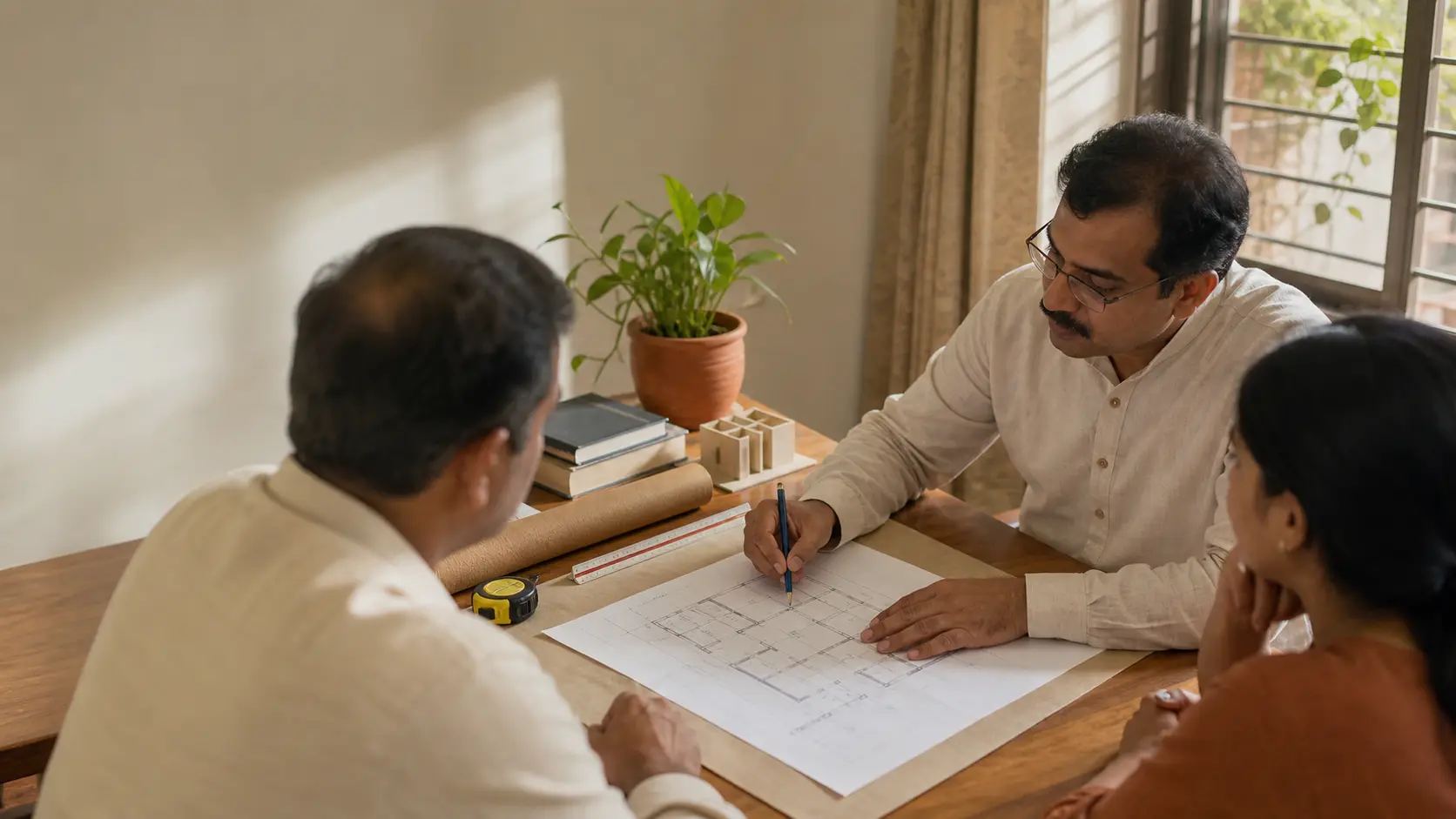
Begin Mukha Dwara assessment with a magnetic compass standing at the center of the main door threshold looking outward. Record the door's exact facing degree. Northeast-facing doors fall between 22.5° and 67.5°. North between 337.5° and 22.5°. East between 67.5° and 112.5°. For challenged directions — South, West, Southwest — classical Upayas begin with threshold protection. Place a brass Swastika above the door lintel for positive Vayu redirection. Hang a fresh green Mango Pallava Toran — mango leaf garland — at the threshold daily; its Prithvi and Jala energies purify incoming Vayu. A pair of Ganapati idols flanking the entrance serves as Dvarapala installation even without formal structural consecration. For Veedhi Shula, a convex mirror on the outer door surface deflects the arrow energy. Salt lamps at the entrance purify Tamoguna air accumulation. A small copper bowl of water with floating marigolds or rose petals at the entrance corner activates the Jala-Shri axis — particularly effective for North-facing doors seeking Kubera energy enhancement. For South-facing doors, a red Hanuman Yantra above the door frame and a thick threshold height differential of at least 2 inches help resist Yama-zone energy infiltration. Avoid any obstruction within 6 feet of the entrance interior: no furniture, no hanging clothes.
Griha Pravesh Puja and Dwara Puja Rituals for Entrance Consecration
The formal consecration of a new entrance — or reconsecration after Dosha identification — is performed through Griha Pravesh Puja, detailed in both the Manasara and the Apastamba Grihya Sutras. Timing is critical: the puja must fall on a Shukla Paksha Tithi — waxing moon phase — ideally Tritiya, Panchami, or Saptami. The Nakshatra should be Rohini, Mrigashira, Pushya, or Hasta. The puja begins with Ganapati Avahana at the threshold. Swastika is drawn with turmeric paste on the door frame. Panchanga Shuddhi — purification of all five elements — is performed with Panchagavya (cow dung, cow urine, milk, curd, ghee) and Gangajal sprinkled at the threshold. The Dvaradevata Mantra invokes the presiding deity of the entrance direction: for East, the Indra Mantra; for North, the Kubera Mantra. A Navagraha Havan follows with nine dedicated Ahutis. Vastu Purush is honored with Vastu Purush Puja at the Brahmasthana. The first crossing of the threshold is performed by the senior woman of the household, right foot first, carrying a Kalasha of water and a lit lamp — both symbols of Lakshmi's arrival. Srikhand paste marks the doorframe at three points: top center, left side at shoulder height, and right side at shoulder height — the Trikona of divine invitation.