
Summary · Quick answer
Ekadashi is the most sacred fasting day in the Vaishnava calendar — and one of the most powerful spiritual technologies in the entire Hindu tradition. This guide covers why it works, how to observe it, and what it truly asks of you.
This is editorial context. Where no primary citation is shown, treat it as a guide, not as a verified claim, personal prediction or medical advice.
What Is Ekadashi and Why the Eleventh Tithi Is Sacred
Ekadashi (एकादशी) literally means 'eleven' — the eleventh lunar tithi (day) in both the waxing (Shukla Paksha) and waning (Krishna Paksha) fortnights of the Hindu lunar calendar, occurring twice each month, 24 times a year. According to the Padma Purana, the most comprehensive text on Ekadashi, the day is not merely an auspicious tithi but is itself a personification — Ekadashi Devi, who emerged from the body of Vishnu during a cosmic battle with the demon Mura. Lord Vishnu, resting during the battle, was protected by the power that emerged from his own body — and that power was Ekadashi. Hence Ekadashi is called 'Hari Vasara' — the day belonging entirely to Hari (Vishnu). The Vishnu Purana states that the merit of fasting on Ekadashi equals the merit of a thousand Ashwamedha Yajnas (horse sacrifices). The Padma Purana goes further, stating that no other fast, no other pilgrimage, and no other act of charity can equal the spiritual merit of a sincerely observed Ekadashi. The spiritual logic is this: on Ekadashi, the subtle body's channels (Nadis) are most open to the infusion of Sattva (pure, luminous quality), and the gravitational pull of the lunar cycle creates natural conditions that support fasting, prayer, and meditation. What requires enormous effort on other days flows naturally on Ekadashi.
This plays out differently in every chart.
See it in yours →Ekadashi Foods: What Is Allowed and What Is Forbidden
The Ekadashi fast is unique in that it is not simply abstaining from all food — it has precise rules about what is permitted and what is forbidden, and the forbidden items are specific and non-negotiable in the classical tradition. Forbidden on Ekadashi: all grains and cereals (rice, wheat, barley, millet, maize — this is the core prohibition), all pulses and lentils, all leafy vegetables (particularly spinach, fenugreek, and drumstick leaves, which are considered Tamasic on this day), and any food cooked with grains. Also forbidden: eggplant, onion, garlic, and honey. Permitted on Ekadashi: all fruits, all roots and tubers (potatoes, sweet potatoes, yam), rock salt (Sendha Namak — never common salt), nuts, dry fruits, milk, yogurt, ghee, buckwheat (kuttu), water chestnut flour (singhara), and amaranth (rajgira). The grain prohibition on Ekadashi has a scientific basis recognized in Ayurveda: the Jatharagni (digestive fire) operates differently on lunar tithi transitions, and grain digestion on these days is said to produce more Ama (toxic undigested residue) than on other days. Fasting from grains reduces the body's physical energy demands, frees up Prana for upward movement through the Sushumna, and creates a state of heightened inner alertness ideal for japa, satsang, and bhajan.
The Daylong Observance: Prayer, Japa, and Vigil
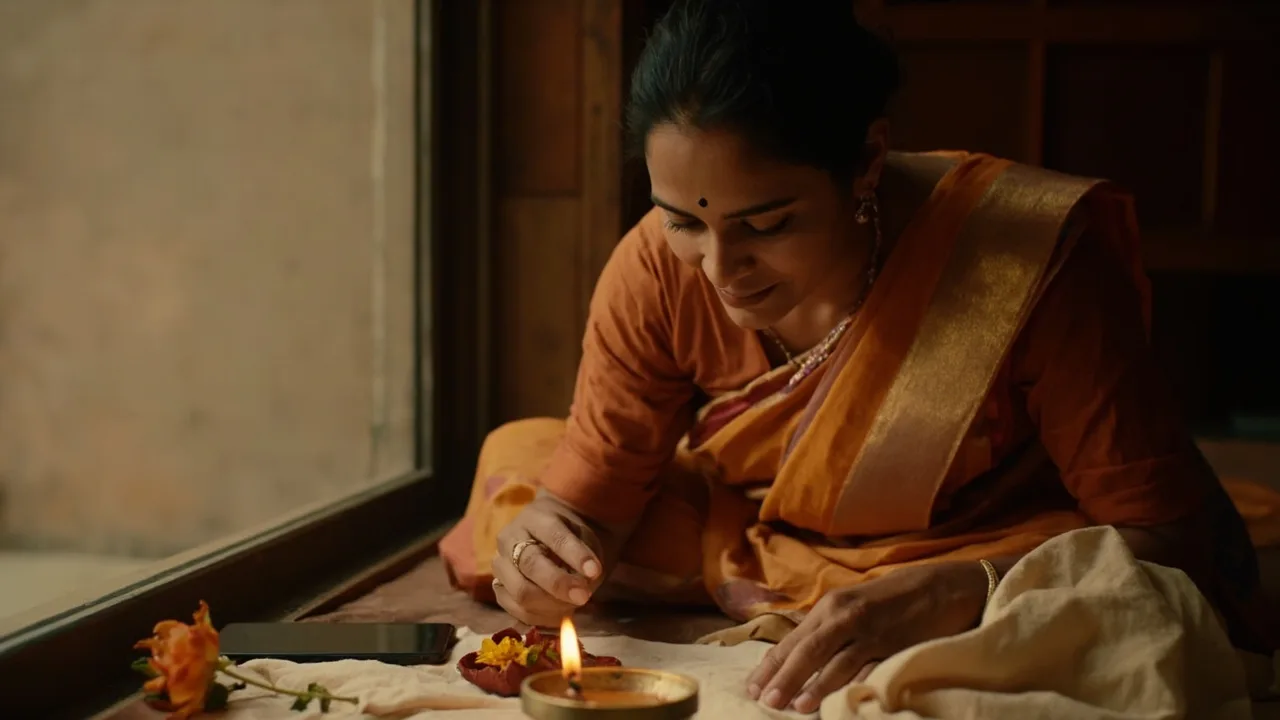
Ekadashi is not merely a dietary practice — it is an all-day devotional observance. The Padma Purana describes the ideal Ekadashi as follows: wake before sunrise, bathe and don clean clothes, visit the temple of Vishnu or set up home worship, offer Tulsi leaves to the Shaligrama or Vishnu image (Tulsi is considered the most beloved of Vishnu's offerings and is mandatory on Ekadashi), light ghee lamps, and spend the day in the chanting of Vishnu Sahasranama, Bhagavad Gita (especially Chapter 15, Purushottama Yoga), or the Vishnu Purana's Ekadashi Mahatmya sections. The rosary (Japa Mala) should be engaged continuously throughout the day with any of these mantras: Om Namo Narayanaya (the Ashtakshara), Om Namo Bhagavate Vasudevaya (the Dwadasakshara), or the Hare Krishna Mahamantra. Spending the night (Ratri Jagran) in devotional singing and prayer without sleeping is considered particularly meritorious on Ekadashi — the Vishnu Purana states that staying awake on Ekadashi night in God's name is equivalent to the merit of a thousand Vaikuntha pilgrimages. The fast is broken the following morning on Dwadashi (the twelfth tithi) after sunrise, with a simple grain-based meal preceded by a sip of Panchamrita or Charnamarita.
The Twenty-Four Ekadashis and Their Special Names
Each of the 24 annual Ekadashis (sometimes 26 in a Adhika Masa leap year) has its own name, its own presiding form of Vishnu, and its own Mahatmya (glorification) story in the Puranas. The most celebrated include: Nirjala Ekadashi (Jyeshtha Shukla — the strictest fast, without even water, said to confer the merit of all 24 Ekadashis combined; recommended only for those with robust health and strong sadhana), Devshayani Ekadashi (Ashadha Shukla — marks the beginning of Chaturmas, the four-month period when Vishnu enters Yoga Nidra; no auspicious events until Prabodhini), Prabodhini or Dev Uthani Ekadashi (Kartika Shukla — Vishnu wakes from his cosmic sleep; marriages resume; one of the most joyously celebrated), Vaikunta Ekadashi (Margashirsha or Dhanurmas — particularly celebrated in South India at Venkateswara and Ranganatha temples, when the Vaikunta Dvara is said to open and darshan carries liberation), and Kamada Ekadashi (Chaitra Shukla — said to fulfil all desires when observed with full devotion). The Padma Purana's Uttara Khanda contains the full narrative for each Ekadashi, and reading or hearing the specific Mahatmya of each Ekadashi before breaking the fast on Dwadashi is itself a prescribed part of the observance.
The Inner Purpose: What Ekadashi Is Really Asking You to Practice
Beyond the physical fast and the prayer schedule, Ekadashi at its heart is a practice of Indriya-Nigraha — control of the senses — and Chitta-Shuddhi — purification of the mind. The Bhagavad Gita's most famous verse on food (Chapter 17, Verse 8) categorises foods as Sattvic, Rajasic, and Tamasic, and the Ekadashi fast is precisely designed to shift the practitioner from Rajasic and Tamasic diet toward a state of complete Sattva — not for one day, but as a training ground for the will and the senses. When you can control what you eat, and how much, on Ekadashi, the capacity for Sattva begins to overflow into the other days of the month. Ekadashi devotees consistently report that their capacity for meditation increases, their temper becomes more even, their speech becomes more measured, and their compassion for others deepens. This is the alchemy of the fast: by withdrawing from one of the most fundamental human drives — the drive to eat — the energy that would have gone into food is redirected upward toward the higher faculties of the heart and mind. Sri Caitanya Mahaprabhu, the great Vaishnava saint, taught that Ekadashi is the day when Maya (illusion) has the least power over the sincere devotee — because the devotee has chosen God over gratification, and that choice, made repeatedly across a lifetime, is the very definition of liberation.