
Summary · Quick answer
The Gayatri Mantra is the mother of all Vedic mantras, a cosmic invocation of divine light and intelligence. But its power is unlocked only through correct pronunciation, timing, posture, and devoted repetition. This is the complete guide.
This is editorial context. Where no primary citation is shown, treat it as a guide, not as a verified claim, personal prediction or medical advice.
The Gayatri Mantra: Its Origin and Cosmic Significance
The Gayatri Mantra (ॐ भूर्भुवः स्वः तत्सवितुर्वरेण्यं भर्गो देवस्य धीमहि धियो यो नः प्रचोदयात्) is a prayer to Savitri — the solar deity who is the divine source of all light, intelligence, and life in this universe. It appears first in the Rigveda (Mandala 3, Sukta 62, Mantra 10), where the sage Vishwamitra received it in a state of deep samadhi. The Manusmriti declares that the Gayatri Mantra, recited one thousand times, purifies the devotee of all accumulated sin, and the Chandogya Upanishad equates it with the essence of the Vedas themselves. It is composed in the Gayatri meter — a 24-syllable meter considered most aligned with the human breath and with the pulsation of the solar force. The mantra has three parts: the Vyahritis (Bhur, Bhuvah, Swah — the three worlds), the Pranava (Om — the primordial sound), and the main prayer asking the divine light (Bhargo) of the supreme being (Devasya) to illuminate and guide the devotee's intellect (Dhiyo). The Devi Bhagavatam proclaims that Gayatri is not merely a mantra but a Goddess — the divine mother of the Vedas — and that she herself resides in the mantra, responding to sincere invocation with the gift of Prajna: awakened intelligence and spiritual illumination.
This plays out differently in every chart.
See it in yours →Brahma Muhurta: The Hour When the Mantra Is Most Powerful
Brahma Muhurta (ब्रह्म मुहूर्त) is the 'hour of Brahma,' approximately 96 minutes before sunrise — typically between 3:30 and 5:30 AM depending on the season and location. Ayurveda and Yoga Shastra both identify this as the Vata-predominant time when the mind is clearest, the atmosphere is charged with Sattvic prana, and the cosmic energy flows most freely between the planes of existence. At Brahma Muhurta, the solar force is approaching the horizon but has not yet physically appeared — and it is precisely in this threshold state, when the divine is imminent but not yet manifest, that invocation has its greatest power. The Vishnu Purana prescribes that the Sandhyavandanam — the tri-daily Vedic worship of which Gayatri Japa forms the core — must be performed at Brahma Muhurta for the morning session. Waking at this hour alone is a spiritual practice: it requires discipline, it disrupts the tendency toward Tamas (inertia), and it aligns the practitioner's biological rhythms with the solar rhythms that Vedic astronomy identifies as the foundation of all earthly life. Those who wish to establish a Gayatri practice but cannot yet wake at Brahma Muhurta may begin at sunrise — the next best timing. Sunset is the third Sandhya and also deeply powerful for Gayatri Japa.
Posture, Direction, and Preparation for Japa
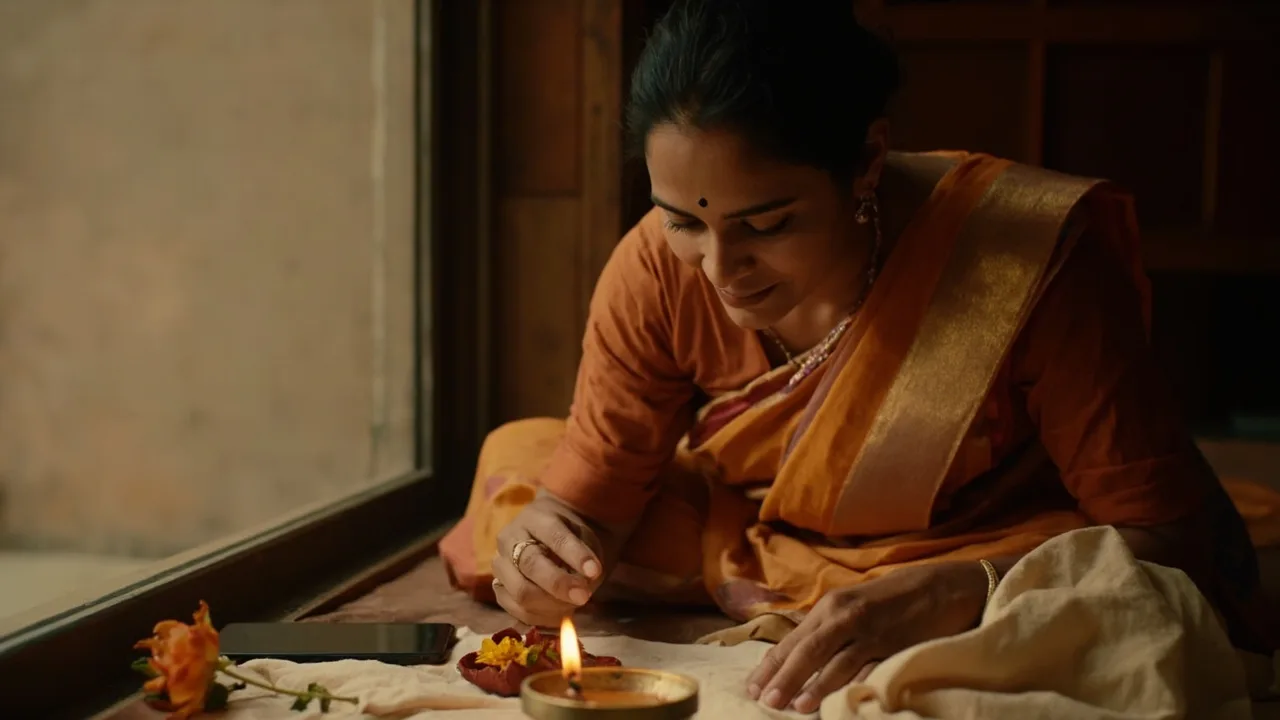
Face east — toward the rising sun or the direction where the sun will rise — for the morning Gayatri Japa. At sunset, face west. Sit in Padmasana (lotus pose) or Siddhasana (adept's pose), or simply sit cross-legged on a Kushasana (kusha grass mat) or a clean woolen or cotton mat. Never sit on leather. The spine should be erect, the chin slightly lowered, the eyes half-closed or fully closed. Place the hands in Chin Mudra or Dhyana Mudra on the knees. After bathing — which is mandatory for the morning practice — wear clean, preferably white or yellow clothing. Touch a little Ganga jal or pure water on your eyes before sitting. Optionally anoint the forehead with chandan (sandalwood paste) tilaka and wear rudraksha mala or tulsi mala. Light a ghee lamp and sandalwood incense before you. Begin with three rounds of Pranayama — inhale for 4 counts, hold for 16 counts, exhale for 8 counts — to purify the Prana Vayus and quiet the mind. Take your Sankalpa: 'I will chant the Gayatri Mantra 108 times for the purification of my mind, the illumination of my intellect, and the grace of Mother Gayatri.' Then take up your Japa Mala of 108 beads.
Correct Pronunciation and the Method of 108 Repetitions
Pronunciation is paramount in Vedic mantra science. Each syllable carries a specific vibratory signature, and mispronunciation — especially of the Udatta (raised pitch), Anudatta (lowered pitch), and Svarita (mixed pitch) accents — diminishes the mantra's potency. Learn the Gayatri from a qualified teacher or a verified Vedic audio source at least once before establishing your personal practice. The 24 syllables are: Om / Bhur / Bhu-vah / Swa-ha / Tat / Sa-vi-tur / Va-ren-yam / Bhar-go / De-vas-ya / Dhi-ma-hi / Dhi-yo / Yo / Nah / Pra-cho-da-yat. Chant at a measured pace — neither rushing nor artificially slow. Each full recitation should take approximately 8 to 10 seconds. For Japa with a mala: hold the mala in the right hand, with the mala draped over the middle finger, the beads turned with the thumb, moving away from you (toward the heart). Never cross the Meru (the large central bead) — when you reach it, reverse direction and begin again. Chant in a low murmur (Upamsu Japa) rather than aloud, so the vibration enters inward rather than dissipating outward. After 108 repetitions, sit for a few minutes in silence and offer the merit of the japa upward: 'Kayena Vacha Manasendriyairva — Buddhyatmana Va Prakriteh Svabhavat — Karomi Yadyat Sakalam Parasmai Narayanayeti Samarpayami.' Then bow to the rising sun with folded hands.
The Inner Fruits of Sustained Gayatri Japa
The classical texts are unambiguous about what sustained Gayatri Japa produces in the practitioner. The Shatapatha Brahmana holds that one who recites the Gayatri correctly for a full year attains the power of ten thousand sacrifices. More practically, devotees who maintain a consistent Gayatri practice — 108 repetitions every morning at Brahma Muhurta for at least 40 consecutive days (one Mandala) — consistently report a qualitative change in the nature of their thinking: thoughts become cleaner, decisions become clearer, and the space between a stimulus and a response grows larger, allowing wisdom rather than reaction to guide action. This is precisely what the mantra asks for — 'Dhiyo Yo Nah Prachodayat' — may the divine illuminate our intellect. Gayatri does not promise material results but the evolution of consciousness that makes all material and spiritual goals achievable. The Devi Bhagavatam further teaches that Gayatri Japa during eclipse times (Surya Grahan, Chandra Grahan), Makar Sankranti, and during the Pitru Paksha carries ten thousand times the ordinary merit. For those undertaking a formal Purascharana — a prescribed number of lakhs of Gayatri repetitions — under the guidance of a Guru, the mantra becomes a direct path to Mantra Siddhi, wherein the deity of the mantra herself responds visibly to the devotee's call.