 Healers World












































 अद्यतनित
 त्वरित उत्तर
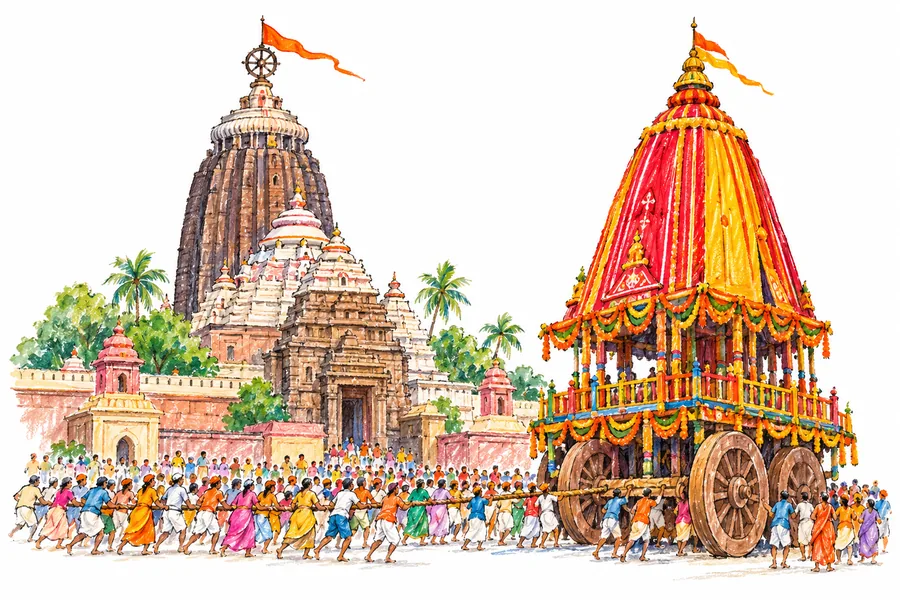
भगवान जगन्नाथ के अधूरे रूप की गहन कथा, विश्व प्रसिद्ध रथ यात्रा शोभायात्रा का अनुभव करें, और जानें यह मंदिर दिव्य अपूर्णता के माध्यम से मोक्ष का द्वार क्यों है।
- विषय
- मंदिर की कहानी
- पढ़ने का समय
- 7 मिनट
- लेखक
- हीलर्स वर्ल्ड स्टूडियो
- अंतिम अद्यतन
- 12 August 2026
The Legend of Jagannath's Incomplete Form and Cosmic Purpose
The Jagannath temple in Puri, Odisha enshrines one of the most paradoxical and spiritually profound teachings in Hindu sacred tradition: the representation of the divine not in perfect, complete form but in a state of deliberate incompleteness that suggests the eternal unfinished nature of creation itself. Unlike most deities depicted in temples with detailed faces, complete bodies, and ornate features, Lord Jagannath is represented as a rounded, almost abstract wooden form with simple features—a large rounded head, minimal facial details, and a cylindrical torso that lacks arms. This apparent incompleteness is not a deficiency or artistic limitation but the central teaching: the divine in its essential form is beyond all particular manifestation, and the moment one tries to complete or perfect the divine's representation, one has already betrayed its true nature by limiting it to form. The legend traces to an ancient narrative in which Lord Krishna (the cosmic divine personality) desired to rest undisturbed in the forest of Nila Madhaba. When he fell into an eternally deep sleep in a cave, his grieving devotees sculpted a wooden form to honor his presence, but the form remained incomplete—the sacred wood seemed to resist the sculptor's attempts to carve the arms, symbolizing that the divine principle cannot be finished or perfected by human effort. According to another account, the unfinished form represents Krishna's promise to appear in each age in the form needed by the consciousness of that age—eternally incomplete because eternally becoming, eternally manifesting in new forms to meet the specific consciousness of the present moment. The teaching embedded in Jagannath's form is that spiritual realization does not consist of achieving some perfect, finished state but of embracing the eternal creative process itself where completion would mean death and incompleteness means infinite possibility. The temple traditions have maintained this profound teaching for over a thousand years: every twelve years, the wooden idol of Jagannath (and his siblings Balabhadra and Subhadra) is ritually dismantled, the wood is inspected for decay, repairs are made, and the deity is reconstructed—a continuous cycle of death and rebirth that suggests the eternal renewal of all existence. This Nav Kalevara (new body) ceremony transforms the temple into a living demonstration that identity is not bound to form, that consciousness can transmigrate between bodies, and that what truly matters about any being is not the physical container but the eternal principle it represents.