 Healers World











































 Updated
 quick answer
Experience the profound legend of Lord Jagannath's incomplete form, the world-famous Rath Yatra chariot procession, and why this temple is the gateway to liberation through divine incompleteness.
- Topic
- Temple Story
- Reading time
- 7 minutes
- Written by
- Healers World Studio
- Last updated
- 12 August 2026
The Legend of Jagannath's Incomplete Form and Cosmic Purpose
The Jagannath temple in Puri, Odisha enshrines one of the most paradoxical and spiritually profound teachings in Hindu sacred tradition: the representation of the divine not in perfect, complete form but in a state of deliberate incompleteness that suggests the eternal unfinished nature of creation itself. Unlike most deities depicted in temples with detailed faces, complete bodies, and ornate features, Lord Jagannath is represented as a rounded, almost abstract wooden form with simple features—a large rounded head, minimal facial details, and a cylindrical torso that lacks arms. This apparent incompleteness is not a deficiency or artistic limitation but the central teaching: the divine in its essential form is beyond all particular manifestation, and the moment one tries to complete or perfect the divine's representation, one has already betrayed its true nature by limiting it to form. The legend traces to an ancient narrative in which Lord Krishna (the cosmic divine personality) desired to rest undisturbed in the forest of Nila Madhaba. When he fell into an eternally deep sleep in a cave, his grieving devotees sculpted a wooden form to honor his presence, but the form remained incomplete—the sacred wood seemed to resist the sculptor's attempts to carve the arms, symbolizing that the divine principle cannot be finished or perfected by human effort. According to another account, the unfinished form represents Krishna's promise to appear in each age in the form needed by the consciousness of that age—eternally incomplete because eternally becoming, eternally manifesting in new forms to meet the specific consciousness of the present moment. The teaching embedded in Jagannath's form is that spiritual realization does not consist of achieving some perfect, finished state but of embracing the eternal creative process itself where completion would mean death and incompleteness means infinite possibility. The temple traditions have maintained this profound teaching for over a thousand years: every twelve years, the wooden idol of Jagannath (and his siblings Balabhadra and Subhadra) is ritually dismantled, the wood is inspected for decay, repairs are made, and the deity is reconstructed—a continuous cycle of death and rebirth that suggests the eternal renewal of all existence. This Nav Kalevara (new body) ceremony transforms the temple into a living demonstration that identity is not bound to form, that consciousness can transmigrate between bodies, and that what truly matters about any being is not the physical container but the eternal principle it represents.
The Rath Yatra: The Divine's Journey Through the Human Realm
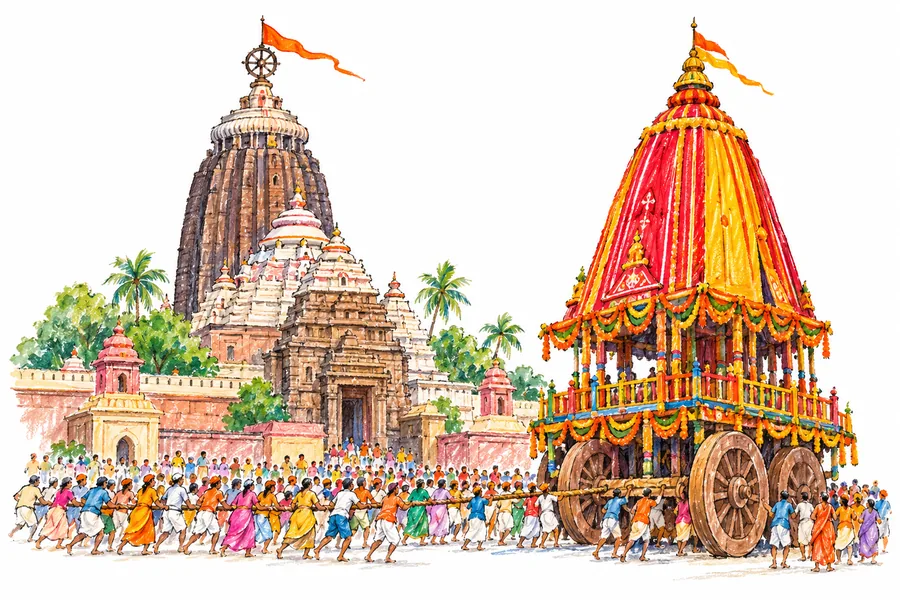
The Rath Yatra (chariot festival) is the world's oldest and largest annual religious procession, attracting millions of pilgrims who gather in Puri each June to participate in pulling the three massive wooden chariots that carry Lord Jagannath, his brother Balabhadra, and sister Subhadra on a sacred journey from the main temple through the streets of the city to a secondary temple called Gundicha Mandir (the garden mansion). The construction of each chariot is an extraordinary feat of engineering: the main chariot of Jagannath stands over 45 feet tall (taller than a five-story building), is constructed entirely of wood without the use of nails or glue (using intricate wooden joints), and requires the coordinated effort of thousands of people pulling ropes to move the massive structure through streets lined with devotional crowds. The construction and decoration of the chariots begins weeks before the festival, with carpenters and artisans carefully selecting sacred wood, crafting each component with precision and devotion, and decorating the chariots with elaborate painted designs and celestial imagery. The Rath Yatra is not merely a religious procession but a cosmic enactment: the journey of the divine from the inner sanctum (the womb-like inner chamber representing formless consciousness) to the outer world (the realm of manifest existence) represents the eternal process of consciousness continuously manifesting itself in form. During the procession, the deity is understood to leave the protected sanctuary of the temple and make himself accessible to all people regardless of their ritual status, caste, or qualification. This radical accessibility suggests that the divine principle is not hidden behind priestly intermediaries or ritual restrictions but is available directly to anyone with sincere yearning. The journey to the Gundicha Mandir is sometimes called the deity's excursion into the human domain, and the return journey (Bahuda Yatra) represents the deity's return to the innermost sanctum of consciousness. The entire cycle encodes the teaching that consciousness continuously moves between transcendence (inner sanctuary) and immanence (manifest world), and the human role is to participate consciously in this eternal divine dance. Millions of devotees believe that participating in the Rath Yatra and pulling the chariots confers moksha (liberation from the cycle of rebirth), suggesting that this practice is understood as a shortcut to spiritual realization by directly engaging with the divine in its most accessible form.
Lord Jagannath, Balabhadra, and Subhadra: The Trinity of Divine Completeness
While Jagannath alone represents the formless divine principle, he is never worshipped in isolation but always with his brother Balabhadra and sister Subhadra, creating a trinity that represents the three fundamental aspects of consciousness and creation. Balabhadra (also called Balarama, meaning the strong one) represents the masculine principle of force, protection, and will—the aspect of consciousness that takes decisive action and establishes boundaries and structures necessary for creation to manifest and persist. Subhadra represents the feminine principle of gentleness, connection, and the womb of creation—the receptive principle through which all manifestation occurs. Together, the three siblings represent the dynamic balance of creation: the transcendent unmanifest divine (Jagannath), the masculine force of manifestation (Balabhadra), and the feminine creative power (Subhadra) together generate and maintain all existence. The relationship between the three deities encodes teachings about complementarity and wholeness: Jagannath alone is abstract and potentially impersonal, but through his relationship with Balabhadra and Subhadra, he becomes relatable and intimate, suggesting that true spirituality balances the transcendent with the personal, the absolute with the relational. The three chariots journey together in the Rath Yatra, but Jagannath's chariot is pulled first, suggesting the primacy of the absolute principle, followed by Balabhadra's chariot and then Subhadra's, representing the ordered unfoldment of manifestation. For pilgrims, encountering the trinity together creates a multidimensional blessing: the formless love of Jagannath, the protective strength of Balabhadra, and the nourishing sweetness of Subhadra combine to create a complete experience of the divine's capacity to meet every human need. The cylindrical wooden form of Jagannath, while apparently featureless, is said to contain within it all possible faces and forms—it is the cosmic egg from which all particular forms of divinity emerge and into which all forms eventually dissolve. The simple painted eyes (chakra-shaped marks) are said to see all beings, all times, all dimensions simultaneously, suggesting that the apparently simple form contains infinite complexity compressed into essential simplicity.
Pilgrimage to Puri: Logistics and Optimal Spiritual Timing
The Jagannath temple is located in Puri, a coastal town in Odisha approximately 550 kilometers from Kolkata, accessible by train, bus, or flight. The town has been a pilgrimage destination for over a thousand years and offers multiple modes of accommodation from simple pilgrim lodges to comfortable hotels. The optimal pilgrimage season extends from October through February when temperatures are mild (15-28 degrees Celsius) and the weather permits comfortable travel and meditation. The Rath Yatra in June (exact dates determined by lunar calendar) is the most significant festival and attracts the largest crowds, though the energy is extraordinarily intense and accommodations become extremely difficult to arrange. Many pilgrims prefer off-season visits that allow for quieter encounters with the deity and more manageable crowds. The main temple features a 212-foot-high gopuram (tower) and intricate architectural details that represent the Kalinga architectural style unique to Odisha. The sanctum sanctorum is approached through multiple concentric chambers, and pilgrims progress toward increasingly inner sanctuaries representing the journey from outer consciousness toward the innermost divine principle. The four gates of the temple (east, west, north, south) represent different points of approach, and circumambulating the entire temple complex becomes a mandala walk that aligns the pilgrim's consciousness with the temple's cosmic geometry. The Gundicha Mandir (the garden mansion) where the deity journeys during the Rath Yatra is a separate temple located about two kilometers from the main temple, and pilgrims can visit both locations during extended stays. The beach of Puri offers an opportunity for ritual bathing in the ocean (called the Mahodadhi or great ocean), a practice believed to cleanse both physical and subtle bodies and to align the seeker with the sacred geography. The temple provides prasad (blessed food) that is famous throughout India for its purity and blessing-infused quality, and consuming prasad at the temple is considered a powerful blessing practice. Many devotees undertake vows of fasting or consuming only prasad during their pilgrimage, amplifying the transformative potential of the sacred visit. The ritual timing of the evening arati (worship ceremony) conducted at specific hours creates powerful energy windows, and pilgrims planning their darshan during arati times often report the most profound spiritual experiences.
What Pilgrims Seek: The Liberation Found in Divine Incompleteness
Devotees journey to Jagannath seeking the blessing of the unfinished divine—seeking not answers or completed understanding but the liberation that comes from embracing the eternal incompleteness of existence. People trapped in perfectionism and the exhausting pursuit of final completion come seeking the teaching that wholeness does not require perfection, that purpose can be fulfilled while remaining incomplete, and that spiritual realization is not the achievement of some final perfect state but the embracing of the eternal process of becoming. The participation in the Rath Yatra creates a unique form of blessing: by pulling the chariot with thousands of others, the individual experiences the dissolution of separateness—the boundaries between self and other, between pilgrim and deity, between puller and pulled begin to dissolve in the intensity of the moment. Many report profound spiritual experiences during the Rath Yatra: the sensation of being swept into something vastly larger than individual ego, direct experiences of divine presence and grace, and a fundamental shift in self-identity from isolated individual toward a localized expression of vast collective consciousness. The specific blessing of Jagannath relates to liberation: many pilgrims report that after sincere prayer at the temple, life circumstances that seemed binding and restrictive suddenly open up, that apparently immovable obstacles begin to shift, and that they find themselves free to move in directions previously blocked. The tradition holds that dying in Puri during a visit to Jagannath guarantees moksha (liberation) in that lifetime, suggesting that the particular frequency of the location and deity enables rapid spiritual transformation even in the moment of physical death. For those struggling with the burden of needing to have all answers, to understand completely, or to achieve perfection, Jagannath's incompleteness offers liberation: the teaching that consciousness itself is eternal, that the universe is eternally unfinished and forever creating, and that the human role is not to complete reality but to participate joyfully in the eternal creative dance. The unfinished form of Jagannath becomes a mirror reflecting back to every pilgrim the truth of their own nature: eternally whole yet eternally becoming, complete as they are yet forever capable of development and transformation, perfect in essence while imperfect in expression. This paradoxical blessing dissolves the false choice between accepting oneself as one is and committing to growth and transformation—both are simultaneously true, and embracing this paradox creates the freedom and joy that represents true spiritual realization.