Daily Discover
A daily feed of the sacred: the live panchang, the festivals and rituals worth knowing, the temples and their stories, and honest answers to the questions everyone asks. No fear, no spam — just what is real, told well.
The feed

The five limbs
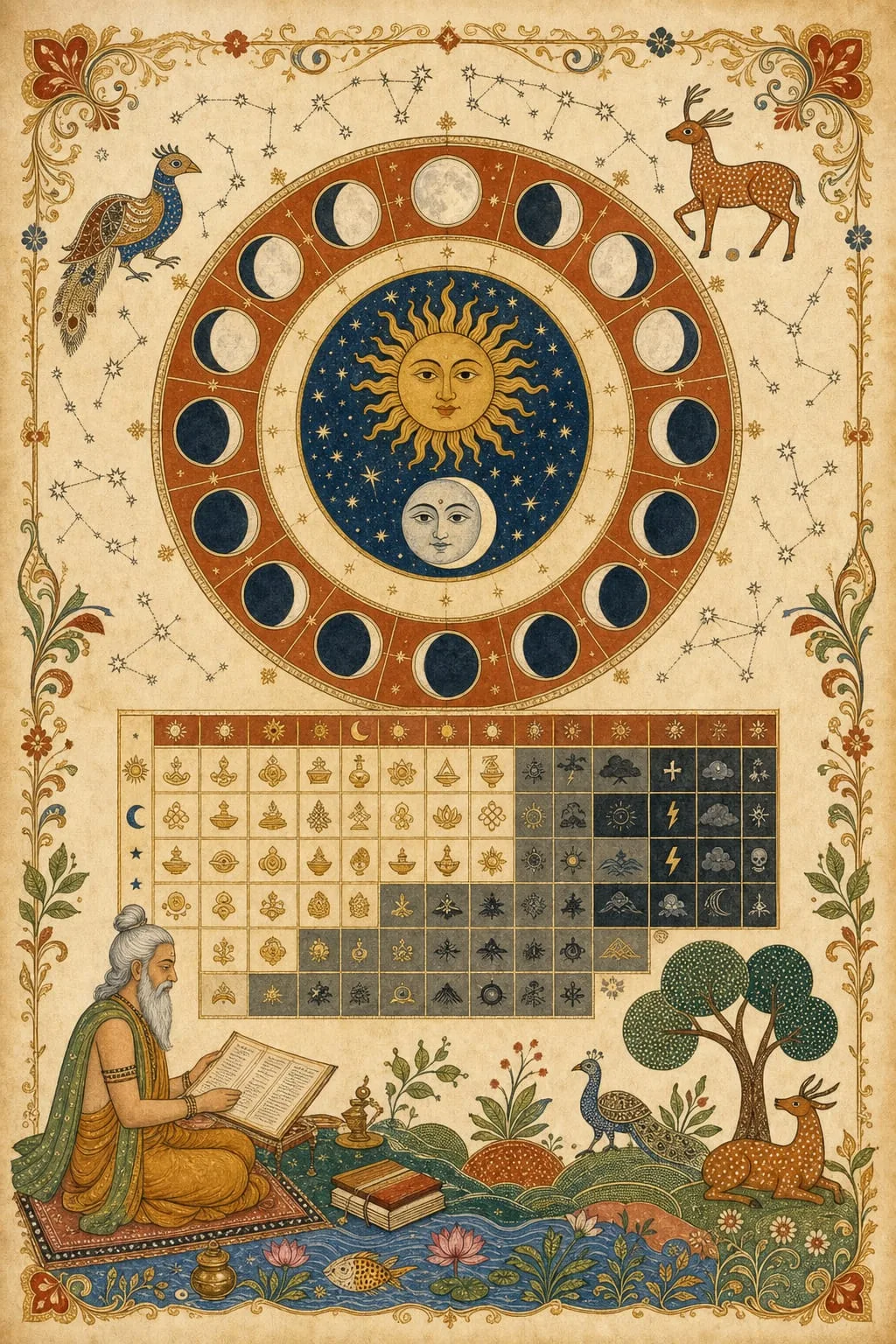
A tithi is the time the Moon takes to gain twelve degrees of separation from the Sun — so the lunar month divides cleanly into thirty of them. Because the Moon moves at an uneven pace, a tithi can run shorter or longer than a calendar day, which is why a date can occasionally repeat or be skipped.

Festival explainer
The festival most people call 'Diwali' is a five-day sequence, each day with its own name and meaning — Dhanteras, Naraka Chaturdashi, Lakshmi Puja, Govardhan Puja, and Bhai Dooj. The central night, Lakshmi Puja, falls on the new-moon (amavasya) of the month of Kartika.

How a ritual works
Abhishekam is the ceremonial bathing of a temple image with substances such as water, milk, honey, and ghee, each poured in a set order while specific verses are chanted. The practice is described across the Agama texts that govern temple worship in South India, and it is among the oldest continuous forms of Hindu ritual.

Temple story
The Kashi Vishwanath temple in Varanasi enshrines Shiva as Vishweshwara, 'lord of all', and is counted among the twelve jyotirlingas. Varanasi is one of the oldest continuously inhabited cities in the world, and the present temple was rebuilt in 1780 by Maharani Ahilyabai Holkar of Indore after earlier structures were destroyed.

Sky event
An eclipse, or grahan, is treated in the panchang as a sensitive astronomical window rather than an omen. Tradition prescribes a sutak period before and after — a pause in cooking and temple worship — and the timing is purely a matter of the Sun, Moon, and Earth's geometry. The mythic explanation is the swallowing of the luminaries by Rahu and Ketu.

Mythology
The Samudra Manthan — the churning of the cosmic ocean by gods and demons for the nectar of immortality — is told in the Mahabharata and several Puranas. Before the nectar rose, a deadly poison emerged, which Shiva drank to save creation, holding it in his throat. It is among the most widely depicted myths in Indian art.

Is this real?
Wearing a gemstone for a planet is a real and old practice in Vedic astrology, recommended in classical texts as a remedial measure. What is honest to say: there is no scientific evidence that a stone changes physical outcomes, and any reputable practitioner frames it as a traditional remedy, not a guaranteed fix. Beware sellers who promise results.

The lunar mansions
A nakshatra is one of twenty-seven equal segments of the zodiac, each about thirteen degrees wide — the 'lunar mansion' the Moon occupies on a given night. The system is far older than the twelve sun-signs in Indian usage, and the nakshatra of your birth Moon is central to traditional naming, matching, and muhurta.

Temple story
The Tirumala temple at Tirupati, dedicated to Lord Venkateswara, is among the most visited places of worship in the world. Its prasadam laddu is so distinctive that it was granted a Geographical Indication tag in 2009 — a legal protection meaning only the temple's own kitchen may call its sweet the 'Tirupati Laddu'.

How a practice works
Vrata (a vow that often includes fasting) and mauna (the practice of silence) are among the oldest self-disciplines in the Indian traditions, undertaken on particular tithis such as Ekadashi. They are framed not as punishment but as a tuning of the body and mind — and where health is a concern, every serious tradition counsels moderation.
Faith Today
Read the panchang against your own chart — cast your free kundli, then go deeper with cited readings, poojas and guidance.