 Healers World









































 Updated
 quick answer
On the banks of the Ganga, in the world's oldest living city, stands a temple where Lord Shiva himself is said to grant moksha to every soul that dies within its sacred bounds.
- Topic
- Temple Story
- Reading time
- 7 minutes
- Written by
- Guruji
- Last updated
- 12 August 2026
The City That Never Sleeps — And Never Forgets
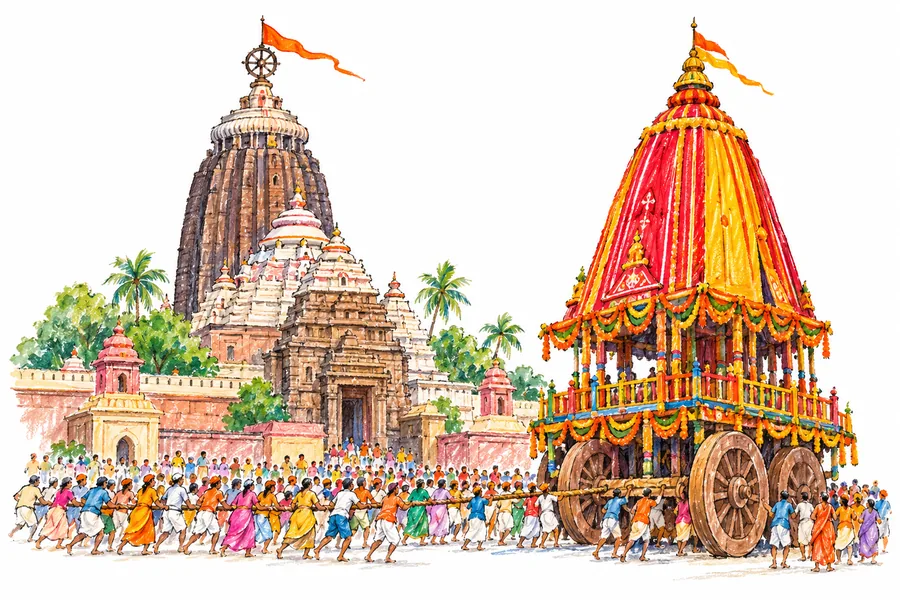
Varanasi, known in the scriptures as Kashi, is not merely a city — it is a cosmic axis, a place where heaven and earth press so close together that the boundary between the living and the liberated dissolves entirely. The Kashi Vishwanath Temple, dedicated to Lord Shiva in his form as Vishwanatha, the Lord of the Universe, sits at the very heart of this ancient metropolis on the western bank of the Ganga. Scholars and archaeologists agree that Varanasi is among the oldest continuously inhabited cities on earth, with human settlement stretching back more than 3,000 years. Yet Kashi, in the Hindu understanding, is older than time itself — it is said to exist before creation and will remain after dissolution. Mark Twain famously wrote that Benares is older than history, older than tradition, older even than legend, and looks twice as old as all of them put together. For Hindus, that is not hyperbole — it is sacred fact.
The Mythology of Vishwanatha — Why Shiva Made Kashi His Home
The Skanda Purana, the Kashi Khanda in particular, dedicates thousands of verses to explaining why Kashi holds the highest spiritual rank among all tirthas. According to tradition, Lord Shiva and Goddess Parvati chose Kashi as their eternal abode after Shiva grew weary of wandering through the cosmos following Sati's death. The city itself is said to rest on Shiva's trident, never touching the earth during the great dissolution (pralaya) — which is why pilgrims say that dying in Kashi is dying on Shiva's own body. The presiding linga at Kashi Vishwanath is one of the twelve Jyotirlingas — self-manifested pillars of light that mark the twelve most sacred Shiva sites across India. The Jyotirlinga here is said to have emerged spontaneously from the ground, blazing with divine radiance, when Brahma and Vishnu disputed who was greater. Shiva appeared as an infinite column of fire whose beginning and end neither god could find — and Kashi was where this cosmic revelation first touched the earthly plane.
The Temple's History — Destruction, Resilience, and Rebuilding
The Kashi Vishwanath Temple has been destroyed and rebuilt multiple times across its documented history, making its very survival a testament to the inextinguishable nature of devotion. The most significant destruction came at the hands of Mughal emperor Aurangzeb in 1669, who ordered the temple demolished and the Gyanvapi Mosque constructed on part of its site. The original rear wall of the temple can still be seen embedded within the mosque's western wall — a quiet, contested presence that devotees visit to this day. The current temple structure was commissioned by Ahilya Bai Holkar, the remarkable queen of Indore, in 1780. Her patronage extended to rebuilding dozens of temples across India that had fallen to ruin or destruction. In 1835, Maharaja Ranjit Singh donated gold to cover the two main domes, giving the temple its iconic golden gleam that catches the morning light above the narrow lanes of the old city. The Kashi Vishwanath Corridor, inaugurated in 2021, dramatically expanded the temple precinct, restoring a direct view from the main sanctum to the Ganga Ghat for the first time in centuries.
The Moksha Promise — Why Dying in Kashi Is a Blessing
Nowhere in Hindu theology is the geography of death more significant than in Kashi. The belief, codified in texts like the Kashi Khanda, is unambiguous: whoever dies within the sacred boundary of Kashi — the Panchakroshi region — automatically receives moksha, liberation from the cycle of birth and death, regardless of their karma or spiritual status. This promise is not considered a metaphor. Shiva himself is said to whisper the Taraka mantra — the Ram Naam — into the right ear of every soul departing within Kashi's limits, ensuring their liberation. This is why the burning ghats of Varanasi, particularly Manikarnika Ghat, have burned continuously for over 2,000 years without interruption, day and night, 365 days a year. Families travel thousands of kilometres to bring their dying elders to Kashi. The Mukti Bhavan, a hostel near the temple, accommodates those who have come to die in the sacred city — and has done so continuously for more than a century. For the devotee, Kashi is not a place of mourning but of supreme celebration.
What the Devotee Experiences — The Golden Temple at Dawn
Arriving at Kashi Vishwanath before sunrise, navigating the narrow stone lanes called galis that are barely wide enough for two people to pass, the devotee enters a sensory world that has barely changed in centuries. The smell of jasmine and marigold garlands mingles with incense and the cool mist rising from the Ganga a hundred metres away. The golden domes catch the first pale light of dawn while priests chant the Shiva Sahasranama in overlapping voices. The queue to enter the inner sanctum — the garbhagriha — can stretch for hours, but the faithful wait without complaint, because the moment of darshan, of standing before the Vishwanatha Jyotirlinga and pouring sacred Ganga water and bilva leaves upon the ancient black stone, is considered among the most powerful spiritual experiences available to a human being. The linga is small, dark, and simply adorned — there is no grandeur in the immediate presence of the divine here, only intimacy. Devotees leave with tilak on their forehead, prasad in their hands, and the unmistakable sensation of having stood at the exact centre of the universe.