




























Preparing your page…
Healers World
Preparing your page…Preparing your page…Preparing your page…
Healers WorldTemple WorldPooja WorldVaastu WorldRare You
Tantric tradition describes seven lotuses along the Sushumna, the central channel of the subtle body. Each has its petals, its element and its seed syllable, and Kundalini rises through them from the base of the spine to the crown of the head.
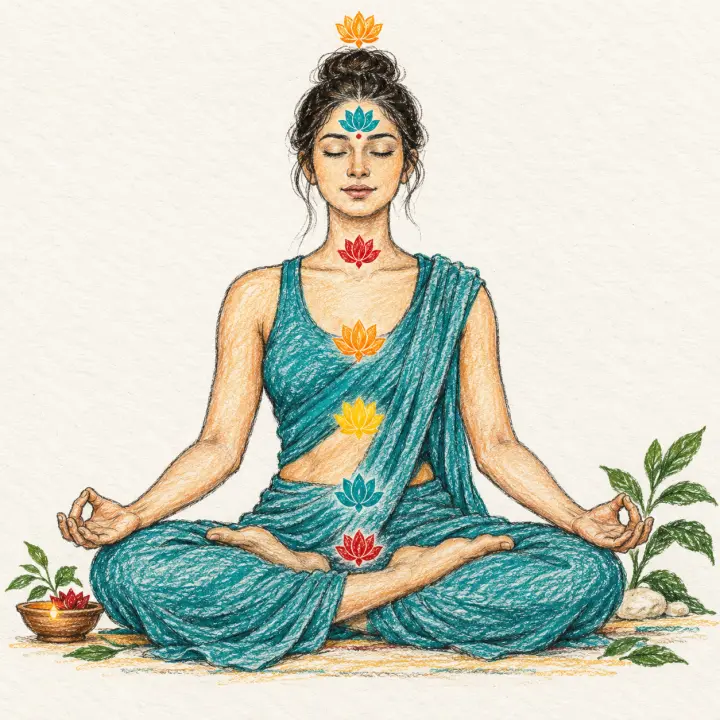


In the yoga and tantra traditions the body has a subtle counterpart, woven of nadis, channels of prana. The chief of them is the Sushumna, running along the spine between Ida and Pingala, and on it sit the chakras, wheels or lotuses, each with its own number of petals.

Kundalini Shakti rests coiled at the base of the spine in the Muladhara. In practice she is awakened and led upward through the six centres, each one dissolving into the next, until she meets Shiva in the thousand-petalled lotus at the crown.
The fullest classical description is the Shat-chakra-nirupana, a sixteenth-century Sanskrit text by Purnananda, which Arthur Avalon translated in The Serpent Power (1919). The petals, elements, seed syllables and placements on these pages follow it.

A firm seat, the spine upright, the breath slow.
Rest your attention where the lotus is placed.
Repeat the bija softly, from Lam at the root to Om.

Move upward one centre at a time, never forcing.
Root to crown, with the petals and seed syllable the Shat-chakra-nirupana gives for each. Open one to read its meaning and practice.
 MuladharaRoot chakra
 SvadhisthanaSacral chakra
 ManipuraSolar plexus chakra
 AnahataHeart chakraVishuddhaThroat chakra
 AjnaThird eye chakra
 SahasraraCrown chakra
Petals, elements, seed syllables and placements: the Shat-chakra-nirupana, tr. Arthur Avalon, The Serpent Power (1919).
What the tradition teaches, and how to begin.

A chakra, a wheel, is one of the centres of the subtle body described in yoga and tantra. Each is pictured as a lotus on the Sushumna, the central channel, with its own petals, element and seed syllable.
The best-known scheme has seven: six centres along the spine, from the Muladhara at its base to the Ajna between the eyebrows, and the Sahasrara, the thousand-petalled lotus above the head. Some texts name more.
A bija is a seed syllable. Each of the first five chakras has one for its element: Lam for earth, Vam for water, Ram for fire, Yam for air and Ham for ether. The Ajna's seed is Om.
Sit upright and breathe slowly. Rest your attention at one centre, chant its seed syllable softly for a few minutes, and move upward only when that feels settled. A teacher of your tradition can guide a deeper practice.
The tradition places them in the subtle body, the body of prana, at points that correspond to places along the spine. They are a map for meditation and devotion.

A cited report reads one area of your life from your exact birth chart. Membership adds more Vaani questions and deeper chart guidance each month.

Your birth chart names the grahas to honour and the mantra for each. The free reading lists them, with the count and the time to chant.