Summary · Quick answer
Holi 2026 begins with Holika Dahan on the Purnima night of Phalguna month and continues with Rangwali Holi the next morning. This guide covers the bonfire ritual, the mythology of Holika and Prahlad, color symbolism, regional traditions, and the spring astrology of Phalguna.
This is editorial context. Where no primary citation is shown, treat it as a guide, not as a verified claim, personal prediction or medical advice.
Holi 2026 Date: Phalguna Purnima and Holika Dahan Timing
Holi 2026 is celebrated over two days: Holika Dahan on the Purnima (full moon) night of the Hindu month of Phalguna, and Rangwali Holi (the festival of colors) on the following morning. Phalguna Purnima in 2026 falls in early March. The Holika Dahan must be performed during the Pradosh Kaal — the period after sunset — when the Purnima tithi is in effect and the Bhadra period (an inauspicious portion of certain lunar tithis) has ended. The Bhadra consideration is critical: tradition strictly forbids performing Holika Dahan when Bhadra is active, and in years when Bhadra extends into the evening of Purnima, the bonfire must wait until Bhadra concludes. Regional panchang authorities provide exact windows for Holika Dahan muhurat. Rangwali Holi, when people celebrate by smearing each other with colors and colored water, takes place on the morning and afternoon of the day following Purnima — called Dhuleti in Gujarat, Dhulandi in Rajasthan, and simply Holi or Phag everywhere else. In Braj (Mathura-Vrindavan), the celebrations extend over many days in advance, with Lathmar Holi in Barsana and Nandgaon being among the most famous in the world, where women traditionally beat men with sticks while the men shield themselves — a playful re-enactment of the mythological games of Radha and Krishna.
This plays out differently in every chart.
See it in yours →Holika Dahan: The Bonfire Ritual and the Story of Prahlad
Holika Dahan — the burning of the Holika effigy — is the ritual foundation of the Holi festival and encodes one of the most powerful stories about devotion, divine protection, and the self-destruction of evil in Hindu mythology. The story comes primarily from the Bhagavata Purana and the Vishnu Purana. King Hiranyakashipu, a demon who had obtained a boon of near-invulnerability through severe austerities, demanded that all his subjects worship him as god and not Lord Vishnu. His own son, the young Prahlad, refused and remained an unwavering devotee of Vishnu despite his father's repeated attempts to have him killed. When every method failed, Hiranyakashipu enlisted his sister Holika, who had a divine boon making her immune to fire, to hold Prahlad in her lap and enter a pyre. Through divine grace, the boon was nullified because it was being used for an evil purpose — Holika burned while Prahlad emerged unharmed, his devotion protecting him where no human shield could. Holika Dahan commemorates this divine protection of righteousness. On the night of Purnima, a pyre is built with dry wood, cow dung cakes, and branches in community spaces. After circumambulation and prayers, the pyre is lit — symbolically burning away the negative energies of winter, the accumulated negativities of the past year, and the Holika-principle of power misused. New grains of the Rabi harvest — barley and wheat — are traditionally held over the flames as an act of gratitude and offering.
Rangwali Holi: Colors, Their Symbolism and How to Celebrate
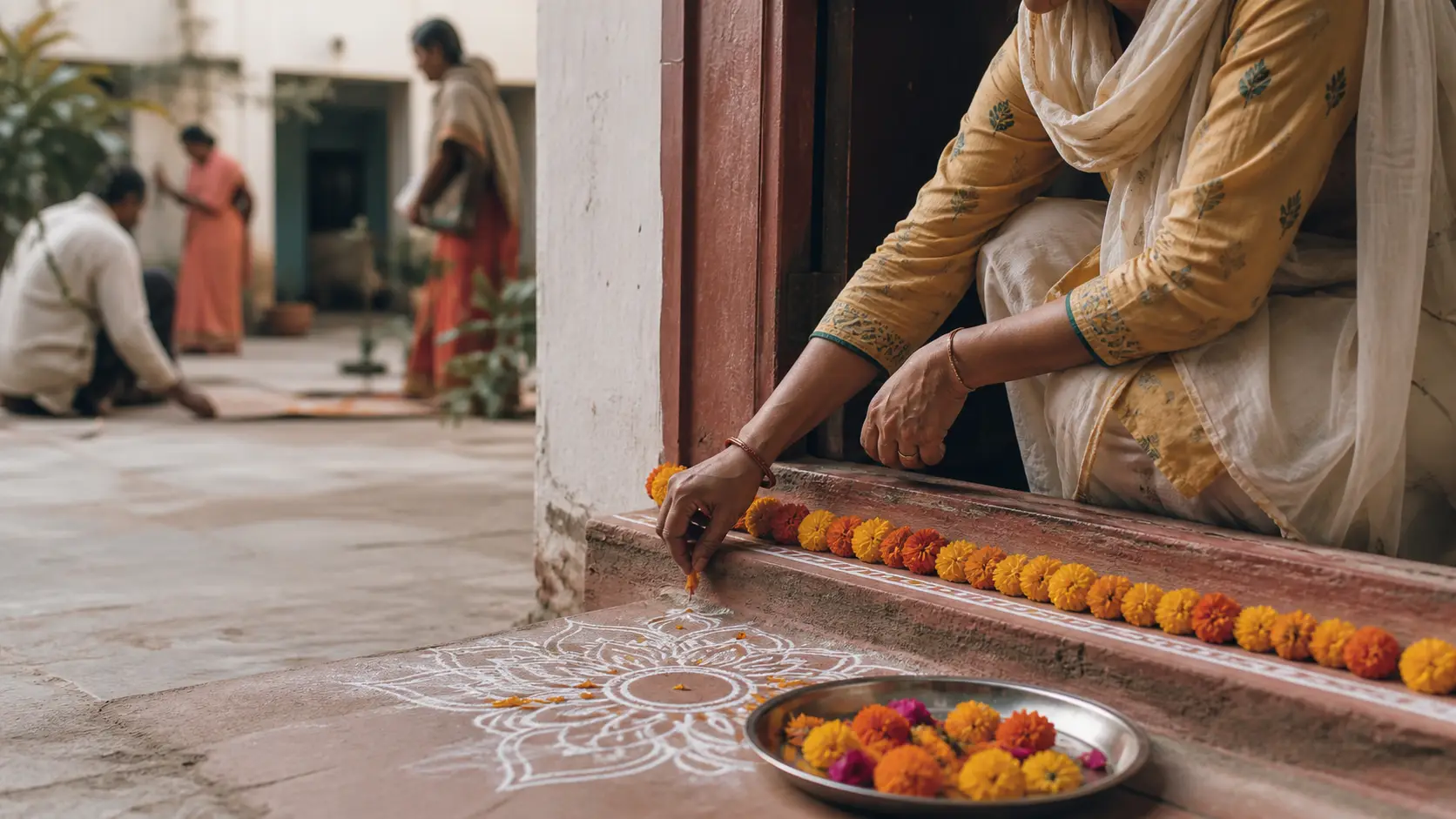
The morning after Holika Dahan brings Rangwali Holi, the joyous, anarchic, and universally beloved festival of colors that has made Holi India's most visually recognizable celebration worldwide. The playing of colors during Holi is traced to the divine love play of Radha and Krishna — the dark-complexioned Krishna was once teased by his mother Yashoda for lamenting that Radha's skin was fair while his was dark, and she suggested he color Radha's face with whatever color he liked. Krishna's mischievous application of color to Radha's face is considered the mythological origin of Holi colors. Traditionally, the colors used in Holi were made from natural sources: red from kumkum (vermillion) or tesu flowers (Flame of the Forest), yellow from turmeric and marigold, green from neem or henna, and blue from indigo. These natural colors had skin-beneficial properties and the post-Holi skin glow is partially attributed to their medicinal qualities. Modern synthetic colors carry health risks including heavy metal content, and there is a growing movement back to natural, herbal, and flower-based Holi colors. The symbolism of smearing colors on one another transcends the merely playful — it is a ritualized dissolution of hierarchy, caste, gender, and formality. On Holi, the normal rules of social conduct are temporarily suspended, the distinction between high and low is colored over, and for a morning at least, all of humanity is made equally vivid, equally impermanent, and equally joyful.
Regional Holi Traditions Across India: From Braj to Bengal
Holi's diversity across India's regions reveals how a single mythological kernel can blossom into dozens of distinct cultural expressions. In Braj — the Mathura-Vrindavan-Barsana-Nandgaon region of Uttar Pradesh — Holi celebrations begin up to a week before Purnima and are the most elaborate in the country. Lathmar Holi in Barsana features women beating men with decorated sticks (lathis) while the men shield themselves and try to drench the women with colored water, enacting the playful antagonism of Radha's friends and Krishna's companions. Phoolon ki Holi (Holi with flower petals) at Vrindavan's Banke Bihari temple is a gentler, overwhelmingly beautiful version where priests shower the assembled devotees with marigolds and rose petals. In Bengal, Holi coincides with Dol Purnima, where idols of Radha and Krishna are placed in decorated swings and taken in procession through the streets while devotees celebrate with color and song — one of the most visually poetic versions of the festival. In Punjab, Hola Mohalla — established by Guru Gobind Singh in 1701 as a military and martial arts festival the day after Holi — features Nihang Sikh warriors performing spectacular displays of horsemanship, sword-fighting, and archery at Anandpur Sahib. In South India, Holi is less universally celebrated but growing in popularity among urban communities as a shared national festival, often with an emphasis on natural colors and community bonding.
Phalguna and Spring Astrology: The Cosmic Context of Holi
Holi's timing in Phalguna Purnima carries precise astrological significance in the Vedic framework. Phalguna is the last month of the Hindu year, and Holi marks its conclusion — a festival at the very end of the annual cycle, when the old year burns in the Holika fire and the new year of Chaitra begins just days later. The Sun during Phalguna Purnima is in late Aquarius or early Pisces, having crossed the most interior and dissolving signs of the zodiac, and is preparing to enter Aries — the beginning of the astrological new year — at Ugadi/Gudi Padwa. This solar positioning means that Holi occurs at the precise cusp of the cosmic inhale and exhale, the moment of maximum dissolution before the energies of spring and new creation surge forward. The Purnima Moon of Phalguna, fully illuminated and in the nakshatra region of Purvabhadra or Uttarabhadra, carries a quality of completion, fullness, and release. The spring equinox is also approaching, bringing with it the rebalancing of light and dark. The ancient fertility associations of Holi — the offering of new grain to the Holika fire, the explosion of color that mirrors the spring blossoming of flowers and trees, the playfulness of male-female interaction that echoes the reproductive energy of spring — are cosmologically coherent with what the planets and the earth are doing at this moment. Holi is not just a social festival but a seasonal alignment ceremony that celebrates the inherent generosity and abundance of nature preparing to burst into full spring.