 Healers World



































 Updated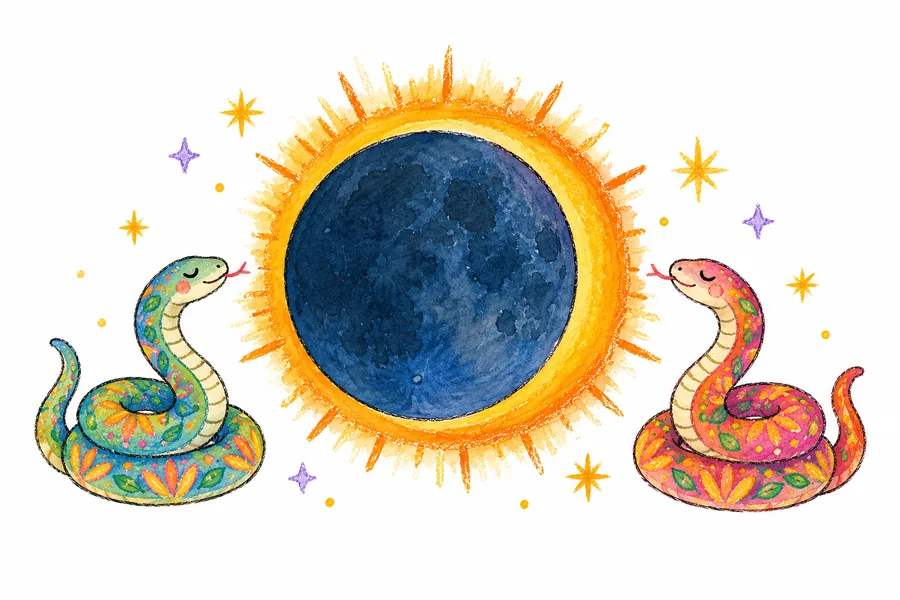
 quick answer
The Rahu-Ketu axis in your birth chart reveals the soul's unfinished business, past life patterns, and the evolutionary direction your soul is moving toward. Rahu shows where you're learning to develop; Ketu shows what you're learning to release.
- Topic
- Rahu and Ketu
- Reading time
- 7 minutes
- Written by
- Healers World Studio
- Last updated
- 12 August 2026
Understanding the Nodal Axis: The Soul's Evolutionary Journey
The Rahu-Ketu axis, also called the nodal axis, represents the soul's past-life karma and its evolutionary direction in this lifetime. Ketu, the south node, represents the soul's past—what you bring from previous lifetimes, your natural gifts and talents, but also your unconscious patterns and unfinished business. Rahu, the north node, represents the soul's future—the direction your evolution is pointing, the qualities you're developing, the lessons you're learning in this lifetime. The axis between them represents the soul's journey: you are learning to move from Ketu (what is comfortable and familiar but limiting) toward Rahu (what is challenging and unfamiliar but necessary for growth). The house placement of the axis shows the life domains where this evolutionary work is happening. In the 1st-7th axis, the soul is learning to move from self-focus (Ketu in the 1st) toward partnership (Rahu in the 7th), or from merger and dependence (Ketu in the 7th) toward autonomy (Rahu in the 1st). In the 2nd-8th axis, the soul is learning about values, resources, sexuality, and transformation. In the 4th-10th axis, the soul is learning about the balance between inner security and worldly achievement. In the 5th-11th axis, the soul is learning about creative self-expression versus collective participation. The sign placements of Rahu and Ketu show the specific qualities involved in the evolutionary work. Rahu's sign shows the qualities you're developing; Ketu's sign shows the qualities you're learning to transcend. Together, they tell the story of your soul's journey.
Past Life Patterns: What Ketu Reveals About Your Soul's History
Ketu in your birth chart shows the gifts, talents, and patterns that carry over from your past life. These are abilities you have naturally—they don't require effort or learning. But they can also be unconscious patterns that limit you if you cling to them too much. Ketu in Aries suggests a past life of courage, willpower, and perhaps warfare or conflict; in this lifetime, you naturally have courage and decisiveness, but you may be learning to soften your warrior energy and develop compassion. Ketu in Taurus suggests a past life of material accumulation and sensory focus; you naturally have good taste, sensuality, and material skills, but you may be learning to release attachment to material security. Ketu in Gemini suggests past-life communication and intellectual development; you naturally understand language, commerce, and information, but you may be learning to develop deeper wisdom beyond intellectual knowledge. Each Ketu placement carries its own past-life resonance and natural gifts, and also its own temptation to cling to familiar patterns rather than growing. The houses of Ketu show which life areas carry this past-life resonance most strongly. If Ketu is in the 1st house, your identity carries past-life patterns; you naturally feel a strong sense of self, but you may be learning to release ego-identification. If Ketu is in the 4th house, your family patterns carry past-life resonance; you naturally understand family dynamics, but you may be learning to release family enmeshment. The gifts of Ketu are real, but they become limitations if clung to too strongly. The soul's evolutionary work is to use these gifts while releasing the unconscious patterns that limit growth.
Future Development: What Rahu Reveals About Your Soul's Direction
Rahu in your birth chart shows the qualities and experiences you're learning to develop in this lifetime. These are abilities that don't come naturally; they require conscious effort and learning. But they are precisely what your soul needs to develop for evolution. Rahu in Aries suggests the soul is learning courage, assertiveness, and independent action; if you tend to be timid or dependent, this lifetime is about developing those qualities. Rahu in Taurus suggests the soul is learning about material resources, sensuality, and self-worth; if you struggle with material security or self-value, this is your learning ground. Rahu in Gemini suggests the soul is learning communication, intellectual flexibility, and connection with others; if you tend to be withdrawn or rigid intellectually, this is your growth edge. Each Rahu placement carries its own evolutionary direction and its own temptation to pursue it obsessively through Rahu's distorting lens. The houses of Rahu show which life areas carry this growth edge most strongly. If Rahu is in the 7th house, partnerships are your soul's primary learning ground; you naturally struggle with relationships, but this lifetime offers opportunity for profound partnership development. If Rahu is in the 10th house, career and public purpose are your growth edge; you naturally lack worldly ambition, but this lifetime is about developing meaningful public contribution. The challenge with Rahu is to pursue its evolutionary direction without the distortion of obsession and hunger. The soul is moving toward these qualities, but Rahu's way of moving toward them is often through grasping, obsession, and illusion. The key is to use Rahu's energy to propel you toward genuine growth while being aware of its tendency toward compulsion and confusion.
The Evolutionary Tension: Working With the Axis
The real work of the nodal axis is learning to release the comfortable but limiting patterns of Ketu while moving toward the challenging but necessary development of Rahu. This is not a simple one-directional movement; it's a dynamic tension that you carry throughout your life. In the early part of life, you may rely heavily on your Ketu gifts—these come naturally and make you feel confident. But as you mature, life will push you more and more toward your Rahu development. If you resist this push, you experience the shadow of Rahu—obsession, confusion, and compulsive pursuits that never satisfy. If you embrace the push consciously, you experience the gift of Rahu—genuine growth and the development of new capacities. Work with the axis by consciously developing your Rahu qualities while mindfully releasing your Ketu attachments. If Rahu is in the 1st house, consciously develop your sense of independent self while releasing dependence on others' approval (your Ketu in the 7th gift). If Rahu is in the 4th house, consciously develop your inner emotional security while releasing family enmeshment (your Ketu in the 10th gift of worldly achievement substituting for inner security). Notice where Ketu's gifts have become unconscious patterns that limit you, and consciously work to release them. Notice where Rahu is calling you toward growth, and consciously move toward that development even though it's uncomfortable. The nodal axis becomes a conscious evolutionary tool when you understand it as a map of the soul's unfinished business and its necessary development.
Living Your Nodal Axis: Integration and Wholeness
The ultimate work of the nodal axis is not to completely abandon Ketu or to completely become Rahu, but to integrate both—to use your Ketu gifts while developing your Rahu capacities, to release Ketu's unconscious limitations while honoring its wisdom, to pursue Rahu's development while avoiding its obsessive distortion. This is the work of wholeness. If your Ketu in the 1st house gifted you with a strong sense of self, bring that strength into your Rahu-7th work of partnership; develop the capacity to maintain your selfhood while genuinely connecting with another. If your Ketu in Taurus gifted you with material skills and sensuality, bring that into your Rahu-Gemini work of communication and mental flexibility; become someone who communicates about material and sensual matters with both knowledge and curiosity. The integration happens when you stop seeing Ketu as the enemy and Rahu as the goal, and instead see them as complementary aspects of a whole self. Your Ketu gifts are real; honor them. Your Rahu development is necessary; pursue it. The soul's evolution is not about becoming a different person, but about becoming more fully yourself—integrating both the gifts you bring from the past and the capacities you're developing for the future. This integration is the deeper work of understanding your nodal axis. The specific interpretation of your personal nodal axis requires knowing your exact birth time and place; the interpretations here are general. But the principle applies to everyone: your soul is here to integrate the past with the future, to honor what you bring while developing what you need to learn, to move from the comfort of Ketu toward the growth of Rahu while creating wholeness from both.
 Rahu and Ketu