 Healers World







































 Updated
 quick answer
Liberation is the fourth and highest goal of human life in the Vedic framework — but it is not an escape from life. Understanding Moksha in the context of Dharma, Artha, and Kama transforms every human aspiration into a step on the path home.
- Topic
- Vedic Astrology
- Reading time
- 12 minutes
- Written by
- Guruji
- Last updated
- 12 August 2026
The Purusharthas: The Four Goals That Organise a Human Life
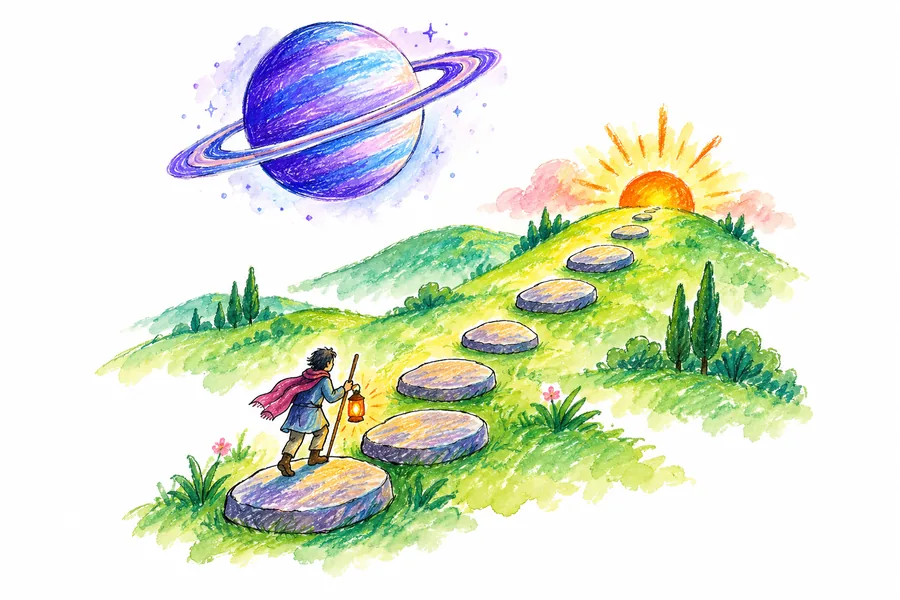
The Vedic tradition does not ask you to renounce the world before you are ready. It meets you exactly where you are. The doctrine of the Purusharthas — the four goals or aims of human life — is one of the most psychologically astute frameworks ever devised for understanding human motivation and guiding it toward its ultimate fulfilment. The four goals are: Dharma (righteous conduct, duty, moral law), Artha (wealth, security, material means), Kama (desire, pleasure, love, aesthetic enjoyment), and Moksha (liberation, freedom, final release from the cycle of birth and death). These four are not arranged in a strict hierarchy in most classical texts. They interpenetrate and support each other. Artha pursued without Dharma becomes exploitation. Kama pursued without Dharma becomes addiction. Dharma pursued without Artha often becomes impractical idealism that cannot sustain itself. The first three goals — Dharma, Artha, Kama — are called Trivarga (the group of three) and together represent the full range of what the embodied, socially engaged soul legitimately pursues and needs. Moksha stands somewhat apart — it is the goal that transcends the other three, the goal that arises when the soul has engaged fully with life, has experienced the full range of human aspiration and its inevitable limitations, and has arrived at the recognition that the deepest longing — the longing for unconditional peace, love, and freedom — cannot be satisfied by anything within the domain of the other three goals.
Dharma and Artha: The Material and Ethical Foundation of Liberation
Artha means wealth, livelihood, material security, and the pragmatic means necessary to live a functional life. The Arthashastra of Kautilya (4th century BCE) treats Artha as a vast and sophisticated domain — statecraft, economics, agriculture, trade, military strategy — all in service of the well-being of the individual, the family, and the society. The Vedic tradition never demonises wealth. The goddess of wealth, Lakshmi, is one of the most beloved and worshipped deities in the entire tradition. The problem is not Artha — it is Artha as an end in itself, pursued at the expense of Dharma and without orientation toward Moksha. When wealth is pursued dharmically — through honest work, fair exchange, and generous giving — it becomes a support for spiritual life rather than an obstacle to it. The householder who funds teachers, temples, and students of the Vedas (dana — giving) is considered to be generating merit that supports both present and future spiritual progress. Dharma, in the context of the Purusharthas, is what ensures that the pursuit of the other three goals does not become destructive. Artha without Dharma creates the robber baron. Kama without Dharma creates the predator. Dharma is the conscience of the other three goals, the ordering principle that ensures that the pursuit of life's legitimate pleasures and achievements does not create suffering for others or deepen karmic bondage for oneself. The tradition is clear that Dharma and Artha, properly understood, are not in conflict — they are mutually sustaining.
Kama: Desire as Teacher and the Problem of Insatiability
Kama encompasses all forms of desire and pleasure — sensory pleasure, romantic love, aesthetic delight, creative fulfilment, the love of family, and all the forms of enjoyment that make embodied life rich and worth living. The Kama Sutra of Vatsyayana is the most famous text in this tradition, but it is one of many — the entire genre of Kamashastra treats sensory and romantic life as a domain of knowledge worthy of careful study and refinement. The tradition's attitude toward Kama is neither puritanical nor nihilistic. The Tantric traditions in particular treat desire as a form of Shakti — divine energy — that can be either dissipated in unconscious pursuit or refined and redirected toward liberation. The problem with Kama is not that it is bad. It is that it is insatiable. Every desire fulfilled generates new desires. The satisfaction of any particular pleasure is temporary — it creates a momentary reduction of tension (the gap between the desiring state and the fulfilled state) that is then filled by the next wave of desire. This is what the tradition calls samsara (the wheel of becoming) — the endless cycling of desire, fulfilment, temporary peace, new desire. The Vedantic diagnosis is that the soul is ultimately seeking its own infinite nature — Brahman, which is Ananda (bliss) — in finite objects. No finite object can provide infinite satisfaction. When this is recognised through direct experience rather than merely intellectually, the energy that was locked in the endless cycle of desire gradually releases and begins to orient toward Moksha.
What Moksha Actually Is: Liberation in Classical Vedanta
Moksha comes from the root muc, meaning to release, to free. It is release from what the Bhagavad Gita calls the wheel of birth and death — the cycle of incarnation driven by ignorance (avidya) and its consequent karma. It is the permanent, irreversible recognition of one's true nature as Brahman — unlimited, unconditioned, self-luminous awareness — and the dissolution of the identification with the limited body-mind self. Shankaracharya describes Moksha as the recognition that there was never actually any bondage. The soul was never actually limited, never actually separate from Brahman, never actually subject to birth and death. Bondage was always a superimposition — maya at work. Liberation is therefore not the acquisition of something new but the removal of a misperception. As the Vivekachudamani says: the only thing to be renounced is ignorance. The tradition distinguishes between Videha Mukti (liberation after the body drops, post-mortem) and Jivanmukti (liberation while still alive in the body). Jivanmukti is the Advaitic ideal — the recognition that does not require death, that allows the liberated individual to continue functioning in the world with complete equanimity, service, and wisdom. Sri Ramakrishna, Sri Ramana Maharshi, Nisargadatta Maharaj — these are examples of jivanmuktas offered by the tradition. They continued to eat, speak, interact, and appear to operate in time — but the inner sense of being a separate, vulnerable, limited self had dissolved entirely.
Moksha in the Birth Chart and Preparing for Liberation in Daily Life
In Vedic astrology, Moksha is associated primarily with the 12th house (loss, liberation, the dissolution of boundaries), the 8th house (transformation, death, and the transcendence of the ego), and Ketu (the South Node, which represents the karmic residue and the pull toward dissolution). A strong 9th house (Dharma) combined with a well-aspected 12th house often indicates a soul with significant past-life spiritual preparation who is close to final liberation in the cosmic sense. Jupiter and Saturn together — the planet of wisdom and the planet of karma — when harmoniously placed, often support a life oriented toward Moksha. The 5th house (poorva punya, past-life merit) shows what spiritual capital the soul has accumulated. It is important not to reduce Moksha to an astrological outcome to be achieved. The tradition is clear that Moksha cannot be 'caused' — it is a recognition of what already is. But the birth chart can reveal the texture of the soul's current evolutionary moment, the obstacles most likely to arise on the path to liberation, and the practices most suited to this particular life. In daily life, the orientation toward Moksha is cultivated through the consistent practice of vairagya (dispassion — holding the things of the world lightly, not clinging), mumukshutva (longing for liberation as the primary orientation of life), satsanga (the company of truth-seekers and realised teachers), and the daily disciplines of study, meditation, and service. These do not cause liberation — but they create the inner conditions in which the recognition can arise.