 Healers World







































 Updated
 quick answer
At Puri in Odisha stands the ancient abode of Jagannath, the Lord of the Universe, whose enormous all-seeing eyes encompass every being without exception. His annual Rath Yatra chariot procession is humanity's oldest and largest festival of divine accessibility.
- Topic
- Temple Story
- Reading time
- 8 minutes
- Written by
- Healers World Studio
- Last updated
- 12 August 2026
The Myth and Origin of Jagannath Puri
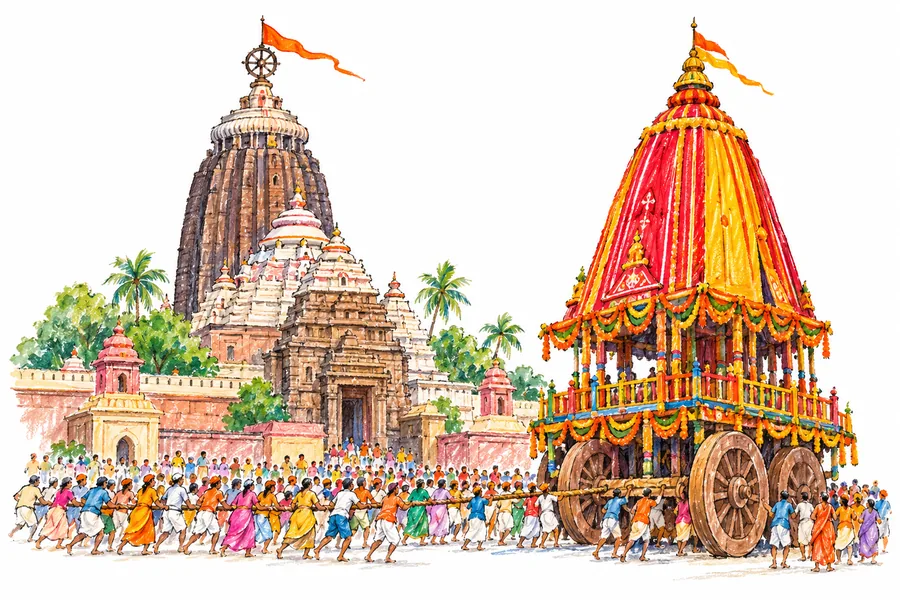
The origin stories of Jagannath are multiple and layered across Vaishnava and ancient tribal traditions, reflecting the deity's unusual iconography — large round eyes without pupils, a dark blue-black complexion, and no clearly defined limbs — which sets him apart from every standard form of Vishnu or Krishna. The most widely told narrative draws from the Skanda Purana and the Odia text Deula Tola. King Indradyumna of Avanti dreamed of the deity hidden in the form of a sacred log on the seashore. He went to the sea, found the log, and invited the divine craftsman Vishwakarma — who appeared as an old man — to carve the deity's image from it. The old craftsman agreed on one condition: he must work in a locked room and must not be disturbed until the work was complete. After many days, the queen, hearing no sound from behind the locked door and fearing the craftsman had died inside, opened the door — and found the three divine images of Jagannath, Balabhadra, and Subhadra still incomplete, without finished limbs. The craftsman had vanished. Brahma then appeared and consoled the heartbroken king, telling him that this was the deity's own chosen form — complete in its incompleteness — and that he would breathe divine life into the images himself. The enormous eyes of Jagannath are understood as all-seeing: encompassing every form of creation without exception, leaving no being outside the deity's vision or compassion, regardless of birth, caste, or spiritual standing.
Historical Significance and Architecture
The Jagannath temple in Puri, Odisha, is one of the four Char Dham pilgrimage sites of Hinduism, alongside Badrinath, Dwarka, and Rameswaram — making it one of the four sacred points that define the spiritual geography of India's four directions. The temple has been a center of Vaishnava worship for at least a thousand years, and references to a shrine at Puri appear in texts dating to the early medieval period. The current structure was built by the Ganga dynasty king Chodaganga Deva in the twelfth century CE and is a supreme example of Kalinga architecture. The Deula (sanctum tower) rises to approximately 65 meters and is topped by the Sudarshana Chakra and the Nilachakra — an eight-spoked wheel of eight metals visible from the sea — and a temple flag that always flies in the direction opposite to the wind, a phenomenon devotees experience as a living sign of the deity's active presence. The temple's famous kitchen, the Rosaghar, is said to be the largest in the world, feeding thousands of pilgrims daily with the Mahaprasad — food cooked in earthen pots over wood fire in the prescribed traditional manner. The Mahaprasad from Jagannath carries a unique spiritual authority: it is offered first to the deity, then distributed, and tradition holds that all who eat it stand equal before the Lord, dissolving the distinctions of caste and rank that otherwise govern much of Indian society.
How to Reach Jagannath Puri and Best Time to Visit
Puri is located in the state of Odisha on the Bay of Bengal coast, about 60 kilometers from the state capital Bhubaneswar. Biju Patnaik International Airport in Bhubaneswar is the nearest major airport, with connections to Delhi, Mumbai, Kolkata, Bengaluru, Chennai, and Hyderabad. From the airport to Puri, the journey by road takes about one to one and a half hours. Puri railway station is a major terminus with direct train connections from Howrah (Kolkata) via the Jagannath Express, Delhi via the Purushottam Express, Mumbai, Chennai, and many other cities, making it accessible from virtually any part of India. The railway station is about one kilometer from the main temple complex. Puri is also an established seaside town, so accommodation options range from budget dharmashalas to comfortable hotels near both the temple and the beach. The best time to visit is between October and February for pleasant coastal weather. The Rath Yatra — the Chariot Festival — falls in the Hindu month of Ashadha (June or July) and is the single most important event associated with Jagannath worldwide, drawing millions of pilgrims to Puri for the procession along Grand Road. The Snana Yatra (the bathing festival of the deities) held a month before Rath Yatra is also deeply significant and marks the beginning of the festival season.
Rituals and Darshan Protocol
Entry to the Jagannath temple at Puri is strictly restricted to Hindus. Non-Hindu visitors, including foreign tourists, are not permitted inside the main temple complex — a policy maintained for centuries that reflects the temple's ancient protocols and the particular sanctity of the inner spaces. Photography inside the temple is strictly prohibited. The daily ritual cycle inside the Jagannath temple is one of the most elaborate in India, encompassing sixteen distinct sevas from before dawn until past midnight, including ritual waking, bathing, dressing, the offering of multiple formal meals at the prescribed times, afternoon rest, evening aarti, and finally the ceremony of laying the deity to rest for the night. The deities are dressed in elaborate silks that change according to the Hindu calendar — specific sets of prescribed garments mark specific days, festivals, and seasons. The Mahaprasad from the temple kitchen is available for purchase by Hindus at designated stalls just outside the temple and carries spiritual authority regardless of how it is received. The Simhadwara (Lion Gate), the main eastern entrance, opens for morning darshan from approximately 5:00 a.m. The Rath Yatra is the one occasion when the normally temple-bound deities emerge onto Grand Road in their massive wooden chariots — and on that day, the darshan is technically open to all who stand along the route, as the deity enters the public domain and makes the full extent of his compassion physically accessible.
Spiritual Experience and Blessings Sought
Jagannath's form itself carries the most essential spiritual teaching of this temple: the large, unfinished, all-encompassing eyes are understood as the eyes of pure consciousness — seeing without preference, without exclusion, without the distinctions that human beings erect between themselves and each other. The Mahaprasad tradition, in which food cooked in the temple kitchen becomes equally sacred when eaten by a brahmin priest or any other person, is one of Hinduism's most radical and enduring expressions of spiritual equality in practice. Devotees who stand before Jagannath in the inner sanctum describe the overwhelming experience of being seen — completely, without judgment, by something that knows them far more thoroughly than they know themselves. Puri is one of the four Mukti Kshetras (fields of liberation) in Hindu geography, and many elderly devotees travel here to spend their final years or days in Jagannath's city, as dying in Puri is traditionally said to grant moksha directly. Younger pilgrims come seeking healing, guidance through life's most uncertain passages, relief from grief, and the grace of surrender to something larger than their own understanding. The Rath Yatra carries its own specific spiritual power: simply standing in the path of the chariot procession, touching the ropes, or catching sight of the deity as the enormous wooden vehicle moves through the crowd is said by tradition to grant the accumulated merit of many lifetimes of pilgrimage. The sea is a short walk from the temple, and many pilgrims take a predawn bath in the Bay of Bengal at the Swargadwar ghat before entering the temple — the meeting of ocean, shore, ancient stone, and divine presence generating a grace that Puri's devotees call the blessing of Purushottama, the highest of persons.