 Healers World









































 Updated
 quick answer
Perched on the Nallamalai hills above the Krishna river, Mallikarjuna Srisailam is one of India's rarest sacred sites — both a Jyotirlinga and a Shakti Pitha, where Shiva and Goddess Bhramaramba dwell together as two faces of a single mountain grace.
- Topic
- Temple Story
- Reading time
- 9 minutes
- Written by
- Healers World Studio
- Last updated
- 12 August 2026
The Myth and Origin of Mallikarjuna Jyotirlinga
The principal myth of Srisailam draws from the Skanda Purana and concerns the great wedding crisis of Kartikeya (also known as Muruga). When Shiva and Parvati organized a contest for their sons — that whichever completed a circumambulation of the universe first would marry first — Kartikeya mounted his peacock and flew off around the world. Ganesha, understanding that his parents represented the universe itself, simply walked around them once. Ganesha won, married, and received the first blessing. When Kartikeya returned and learned what had happened, he was furious and heartbroken. He left the family home on Mount Kailash and settled on Shri Shaila, a mountain in what is now Andhra Pradesh, announcing he would remain there as an ascetic. Shiva and Parvati followed, overcome with parental love, and took up residence on the mountain in a form of light that became the Jyotirlinga Mallikarjuna. The name combines Mallika — jasmine, the flower most dear to Parvati — and Arjuna, a name for Shiva meaning bright or white. The mountain is also a Shakti Pitha: the upper lip of Sati is said to have fallen here, and Parvati is worshipped as Bhramaramba — the Goddess of Bees — a reference to legends of her appearing in that form to battle demons on this mountain, revealing that the sweetness of the divine is also its most ferocious defense.
Historical Significance and Architecture
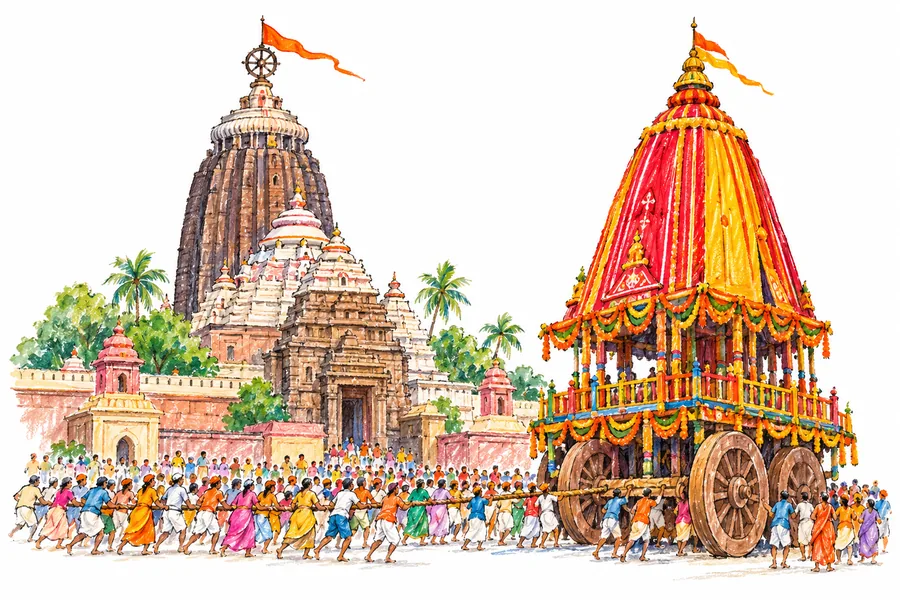
Srisailam is located in the Nallamalai hills in the Nandyal district of Andhra Pradesh, high above the steep gorge through which the Krishna river flows. The site's dual status as both a Jyotirlinga and a Shakti Pitha makes it one of the holiest points in the subcontinent's entire sacred geography — a convergence found at no other location. The temple appears in ancient texts including the Mahabharata, which mentions the site as Shri Parvata, the mountain of the goddess. The great Shaiva poet-saint Akka Mahadevi is associated with Srisailam; tradition holds that she merged with the divine at this very site at the end of her earthly journey. The temple's construction history spans many centuries and dynasties: the Satavahanas, Chalukyas, Kakatiyas, and the Vijayanagara kings — who made major contributions to the temple's grandeur — all left architectural imprints. The massive complex includes a huge outer wall enclosing multiple mandapas, subsidiary shrines, and the sacred Mallikarjuna linga. The separate Bhramaramba Devi shrine stands within the same walled complex. The Srisailam dam and reservoir on the Krishna river below has created a dramatic visible backdrop, and the dense Nallamalai forest surrounding the plateau is a tiger reserve — adding untouched, wild grandeur to the spiritual atmosphere that few pilgrimage sites in India can match.
How to Reach Mallikarjuna and Best Time to Visit
Srisailam is situated approximately 212 kilometers from Hyderabad in Telangana, 180 kilometers from Kurnool in Andhra Pradesh, and about 230 kilometers from Vijayawada. The nearest airport is Rajiv Gandhi International Airport in Hyderabad; most pilgrims travel by road from there, a journey of about four to five hours through the Nallamalai forest ghat roads. There is no railway station at Srisailam itself; the nearest stations are Markapur Road (about 90 km) or Kadapa, about 120 km away. APSRTC runs buses from Hyderabad, Kurnool, Nandyal, and other cities with regular schedules. The roads approaching Srisailam wind through the Nallamalai forest and are scenic but narrow in sections; night driving is not recommended. The best time to visit is between November and February. Mahashivratri is the largest festival, drawing hundreds of thousands of pilgrims. The Ugadi (Telugu New Year) puja is also highly significant. An overnight stay in Srisailam is strongly recommended: it allows for the 6:00 a.m. Mallikarjuna darshan in the morning, the Bhramaramba Devi darshan in the afternoon, and the descent to Patala Ganga on the Krishna river at dawn — together these constitute the complete Srisailam pilgrimage experience.
Rituals and Darshan Protocol
The Mallikarjuna and Bhramaramba temples follow a schedule of six sevas daily, beginning with the Nijapadapuja at 6:00 a.m. and ending with the Ekantaseva at 9:00 p.m. The main Rudrabhisheka of the Jyotirlinga traditionally uses water from the Patalaganga — a sacred spring within the Krishna river gorge far below the hilltop temple — which requires a steep descent of over a thousand stone steps and is itself a pilgrimage within the pilgrimage. This descent to the Krishna is typically undertaken at dawn and involves substantial physical effort; pilgrims with mobility limitations can still receive the full benefit of the temple rituals without making this descent. Abhisheka with milk, panchamrita, and Narmada water is performed during the morning sevas. The Mallikarjuna linga itself is adorned with jasmine flowers — the flower of the goddess — as a direct expression of the myth that names this shrine. The Bhramaramba Devi temple requires separate entry and timing, typically in the afternoon. The temple trust manages ticketed special darshans, abhishekas, and sevas that must be booked at the trust office in Srisailam town. Photography is not permitted inside either shrine. Devotees are advised to dress in traditional attire, and the sanctum protocol requires the same respectful preparation as other Jyotirlinga temples.
Spiritual Experience and Blessings Sought
Srisailam offers a pilgrimage experience of unusual depth because of its dual status. Devotees here encounter both Shiva in his Jyotirlinga form and Parvati in her fierce, protective form as Bhramaramba within the same walled complex, and the experience of moving from one sanctum to the other carries the feeling of completing a circuit of the divine masculine and feminine as unified rather than separate forces. The forest environment — deep, dense, and inhabited by tigers and leopards whose presence pilgrims sometimes sense in the night — adds to the experience of entering sacred wild space where the ordinary rules of civilization are briefly suspended. The blessings most frequently sought at Mallikarjuna include marital harmony and reconciliation in family relationships (the myth of Kartikeya's grief and his parents' pursuit of him with love makes this particularly resonant for families), fertility and blessings for children, healing of chronic and inexplicable ailments, and protection during dangerous professions or extended journeys. Pilgrims who descend to Patala Ganga at dawn and stand in the Krishna river far below the temple, surrounded by the towering walls of the gorge and the absolute silence of early morning, describe it as one of the most disorienting and expansive spiritual experiences available anywhere in India. Both Shiva and Shakti dwell here at full power, and the pilgrimage calls on both with equal measure.