 Healers World








































 Updated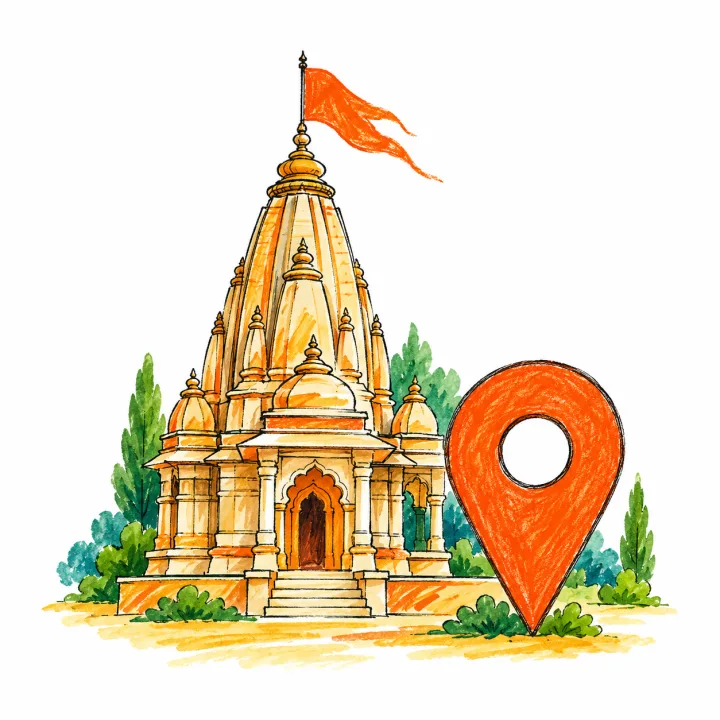
 quick answer
He arrived as a stranger, slept on bare ground, said Allah Malik and Ram Raja in the same breath, and in doing so, quietly dismantled every wall humanity builds between the sacred and the other.
- Topic
- Temple Story
- Reading time
- 7 minutes
- Written by
- Guruji
- Last updated
- 12 August 2026
The Stranger Who Came and Never Left
Sometime in the mid-19th century, a young man appeared in the small village of Shirdi in the Ahmednagar district of Maharashtra. No one knew where he had come from. He wore a tattered kafni robe and a cloth cap, he had no possessions, no family, and no fixed identity in the world's terms. He took up residence in a dilapidated mosque he called Dwarkamai — the Dwaraka of the Mother — and he lit a perpetual fire there that he called the dhuni, feeding it with wood, tending it day and night, distributing its ash as udi (sacred ash) to all who came. This fire burned throughout his lifetime and continues to burn today in the same mosque, never extinguished. The young man said Allah Malik — God is the Master — and he said Ram Raja — God is King — with equal frequency and equal reverence. He prayed in the style of a Muslim fakir and welcomed the rituals of Hindu devotees without distinction. He was, by every external marker, impossible to categorise. The villagers of Shirdi eventually accepted this impossibility and simply called him Baba — Father.
The Life of the Saint — Miracles as Daily Currency
Sai Baba of Shirdi lived in the village for several decades before his mahasamadhi in 1918, and during that time the accounts of his actions — compiled in the Shri Sai Satcharita, written by devotee Govind Raghunath Dabholkar — describe a continuous flow of miracles woven so casually into the fabric of ordinary life that the miraculous and the mundane become indistinguishable. He is said to have lit the mosque's oil lamps one evening when the oil merchants of the village, as a prank, refused to sell him oil — and instead filled his lamps with water from a metal pot, water that burned through the night like the finest lamp oil. He sent devotees on errands to specific locations where they would encounter strangers whose problems he had already arranged to be solved. He appeared simultaneously in different physical locations to different devotees. He manifested food, money, medicine, and comfort for the poor of Shirdi, asking only a small dakshina (offering) in return — not for its monetary value but because, he said, giving something up loosens the grip of attachment. He cured the sick, guided the lost, and apparently knew the private thoughts of everyone who sat before him.
The Mosque-Mandir Unity — A Theology Lived, Not Preached
What makes Sai Baba theologically remarkable is not what he said but what he did. He taught almost nothing in the conventional sense — no elaborate philosophical system, no written texts, no formal religious instruction. His teaching was entirely demonstrated through action. He lived in a mosque. He kept a perpetual fire — the dhuni — which is a distinctly Hindu sacred practice. He celebrated Hindu festivals and Muslim observances with equal participation. He quoted from the Quran and the Ramayana in the same conversation. His closest devotees included devout Hindus, orthodox Muslims, and members of every caste. He accepted food cooked by women of all castes and ate with everyone, an act of radical social levelling in the caste-stratified society of 19th-century rural Maharashtra. He never asked anyone to change their religion or their practice. His consistent message, expressed in simple Marathi and Urdu mixed together, was Sabka Malik Ek — The Master of all is One. This was not a philosophical claim he made but a reality he demonstrated every day of his life for over six decades.
The Samadhi Mandir — Where the Saint Rests and Receives
Sai Baba left his body on October 15, 1918, and was buried in the Booty Wada, a building originally intended as a personal residence for a wealthy devotee named Gopalrao Gund Booty. Baba had reportedly said during his lifetime that he would rest in the Booty Wada — devotees understood this only after his passing, when the building became his samadhi (memorial shrine). The Samadhi Mandir that stands today in Shirdi is built around this original structure and houses the white marble samadhi on which Sai Baba's life-size marble image was installed. The temple complex also includes the Dwarkamai mosque with the original dhuni still burning, the Chavadi where Baba slept on alternate nights, the Lendi Baug garden where he tended a small garden and meditated, and the Gurusthan, the neem tree under which the young stranger was first seen by the village. Each of these locations is an active shrine, visited and worshipped continuously. The Samadhi Mandir attracts over 25,000 devotees daily, surging to over 100,000 during major festivals, particularly Rama Navami and Guru Purnima.
What the Devotee Finds — A Father Who Never Turns Away
The experience of arriving at Shirdi is unlike most major pilgrimage centres in India, which tend toward grandeur and spectacle. Shirdi is modest in scale, intimate in character, and its atmosphere is one of surprising quiet despite the crowds — or rather, the crowds seem to generate a kind of collective stillness that is the opposite of what one might expect. Long queues form outside the Samadhi Mandir at all hours of the day and night, and devotees wait patiently — many singing Sai Baba's aartis softly, some performing pradakshina of the complex, all moving through the warmth and incense toward the inner shrine. The marble samadhi of Sai Baba is draped in flowers and silk, and the white image above it is lit to warm effect. Devotees touch their foreheads to the cool marble edge of the samadhi, press their hands against it, or simply stand with eyes closed for long moments in an interior conversation that no observer can access but every observer recognises. Outside, the udi — the sacred ash from the ever-burning dhuni — is distributed freely, just as Baba distributed it in life. Devotees carry it home wrapped in paper packets and apply it to the forehead, the chest, the sick and the worried. The medicine, they will tell you, is real.