 Healers World








































 Updated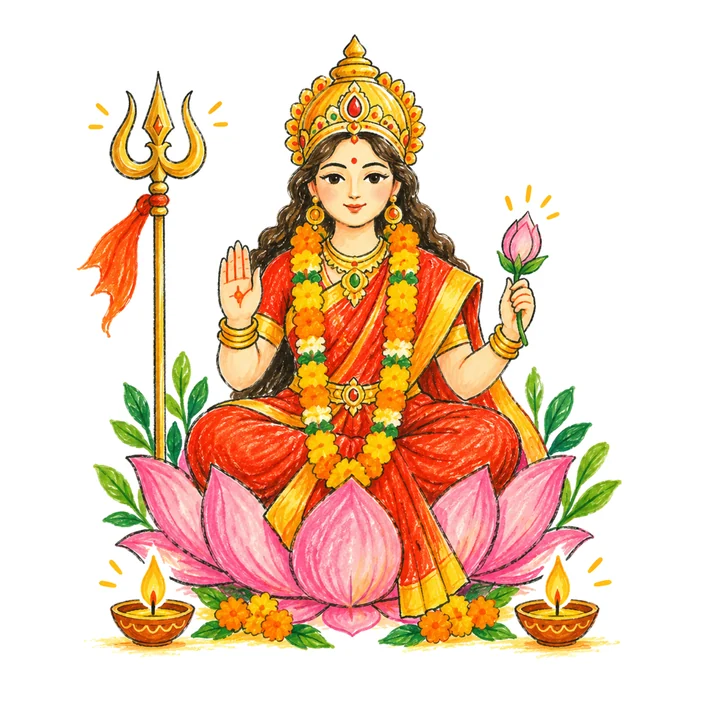
 quick answer
Diwali is not one story — it is a convergence of cosmic events on the darkest new moon of autumn: a king comes home, a goddess descends, and a tiny clay lamp becomes the most powerful spiritual technology in the Hindu tradition.
- Topic
- Festival
- Reading time
- 9 minutes
- Written by
- Healers World Studio
- Last updated
- 12 August 2026
The Myth and Story: From Ayodhya to the Cosmos
The most widely known story of Diwali is from the Valmiki Ramayana: after fourteen years of exile and the defeat of the demon king Ravana in Lanka, Lord Rama returned to Ayodhya with Sita and Lakshmana on the new moon night of Kartik. The people of Ayodhya, unable to wait for dawn, lit oil lamps (diyas) along every street, rooftop, and doorstep to guide their beloved king home through the darkness. This act of collective illumination — a city welcoming its righteous king with light — became the template for Diwali. But the festival carries other sacred stories too. In the Mahabharata tradition, the Pandavas returned from their thirteen years of exile on this same day, welcomed by a kingdom that had longed for their return. In the Shakta tradition, this is the night when Goddess Kali danced her terrible dance on the battlefield after slaying Raktabija — and Shiva lay down in her path to absorb her frenzy. The image of Kali with her foot on Shiva's chest is the icon of Kali Puja performed simultaneously in Bengal. In the Jain tradition, Mahavira, the twenty-fourth Tirthankara, attained Moksha on this day. Each tradition adds a layer, but all converge on the same axis: the power of consciousness and light to overcome ignorance and darkness.
Spiritual Significance: Lakshmi's Annual Visit and the Five Lights
On the night of Diwali, Goddess Lakshmi is said to travel through the world and enter only those homes that are clean, well-lit, and filled with joy — homes that have made space for her. This is not a metaphor; in the Vedic cosmology, Lakshmi is the personification of prosperity, grace, and the abundance that flows when consciousness is aligned with dharma. Her visit on this night is the annual renewal of that alignment. The clay diya at the center of Diwali carries a profound symbolism encoded in the five elements: the earth of the clay body, the water used to shape it, the fire of the flame, the air that feeds it, and the space (akasha) in which it burns. Lighting a diya is therefore not a decorative act — it is an invocation of all five elements in their most concentrated form. The oil or ghee that fuels the flame is another layer of meaning: in Vedic ritual, ghee fed to fire is a vehicle for carrying prayers to the divine. Every lamp lit on Diwali night is a prayer in material form. The tradition of lighting at least one lamp at the threshold (the Lakshmi-pada or footstep space) and one in the puja room reflects the understanding that prosperity enters a home the way a guest does — through the door — and dwells where devotion is maintained.
How to Observe Diwali and the Lakshmi Puja
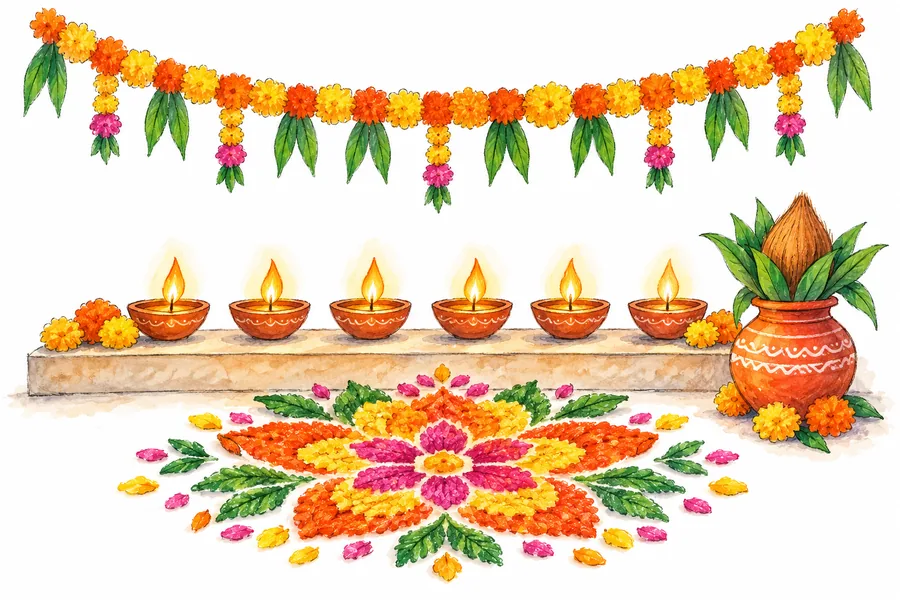
Diwali is a five-day festival. Dhanteras (Dhan Trayodashi) opens the celebration two days before Amavasya, when Lakshmi and Kubera (the god of wealth) are worshipped and new metal items — traditionally silver — are purchased as an invitation for prosperity. Naraka Chaturdashi (Choti Diwali) falls the day before the main festival, commemorating Krishna's defeat of the demon Narakasura. The main Diwali night — Kartik Amavasya — is when Lakshmi Puja is performed. The home is cleaned before sundown and the puja space is prepared with a clean cloth, images or idols of Lakshmi and Ganesh, flowers, rice, turmeric, and sweets. Accounts books (in trader communities), tools of one's profession, and vehicles are also included in the puja as representations of the means through which Lakshmi manifests in daily life. The puja is performed at the Pradosh Kala — the twilight period just after sunset — which is considered her most auspicious window of entry. Rows of diyas are lit around the house and in its courtyard. Fireworks (pataakhe) in traditional understanding are meant to dispel negative energies from the environment, not merely for celebration. The following day, Govardhan Puja commemorates Krishna lifting the Govardhan hill, and the fifth day, Bhai Dooj, mirrors Raksha Bandhan's sibling bond.
Regional Variations Across the Subcontinent
In Gujarat, Diwali is also New Year's Day — the first day of the Vikram Samvat calendar — and is celebrated with tremendous commercial and social significance. Account books are opened with fresh ledgers, business partnerships are blessed, and communities gather for collective Lakshmi Puja in temples and community halls. In Bengal and Odisha, the main worship of this night is Kali Puja, not Lakshmi Puja. Images of the fierce goddess are installed in pandals (temporary shrines) and worshipped through the night with incense, goat sacrifice in some traditions, and all-night prayers. In Maharashtra, the focus is on Lakshmi Puja and the evening meal is a community affair of home visits and sweet-sharing. In Tamil Nadu and Karnataka, the emphasis falls on Naraka Chaturdashi (called Karthigai Deepam in Tamil tradition), with an elaborate lamp-lighting ritual, and the main celebration is the lamp festival of Karthigai Deepam a few weeks later. In North India — particularly in the urban Gangetic plains — Diwali is the grandest festival of the year, with fireworks, family gatherings, gifts of sweets and dry fruits, new clothes, and the elaborately decorated Lakshmi-Ganesh puja at midnight.
Astrological and Tithi Connection
Diwali falls on Kartik Amavasya — the new moon of Kartik, the darkest night of the autumn season. In Vedic astrology, Amavasya is the tithi governed by Pitru (ancestors) and the moon at zero illumination. It is typically considered inauspicious for most activities — which makes Diwali a fascinating exception. The Vedic tradition chose the darkest night of the year precisely because it reveals the fundamental teaching: light is most powerful, most necessary, and most sacred not in the absence of darkness, but in its presence. Astrologically, the sun in Kartik is in Tula (Libra), which is the sign of Libra ruled by Venus — and also the sign where Saturn (Shani) is exalted. Saturn is associated with discipline, karma, and long-term consequences. The festival's emphasis on cleaning the house, settling accounts, and lighting lamps in gratitude before receiving Lakshmi is aligned with Saturnine virtues: preparation, cleanliness, and karmic readiness as prerequisites for abundance. The Pradosh Kala muhurta for Lakshmi Puja is typically derived by calculating when the Amavasya tithi is active and coincides with the Swati nakshatra — which is Lakshmi's own nakshatra and the wind-born star that directly precedes the cosmic center of the zodiac. Families consult the Panchang to determine whether to perform the puja on the first evening (when Amavasya begins) or the second, which varies by geographic location.
 Festival