 Healers World



































 Updated
 quick answer
Raksha Bandhan is more than a thread tied on a wrist — it is a cosmic contract of protection, blessed by the full moon of Shravana, and rooted in stories that span gods, demons, and the undying bond between siblings.
- Topic
- Festival
- Reading time
- 9 minutes
- Written by
- Healers World Studio
- Last updated
- 12 August 2026
The Myth and Story: Yama, Yamuna, and the Thread of Time
Among the many myths woven into Raksha Bandhan, the story of Yama and Yamuna is one of the oldest and most poignant. Yamuna, the sacred river goddess and daughter of Surya, tied a protective thread on the wrist of her brother Yama, the god of death, and prayed for his long life. Yama — the very deity who governs death and dharmic reckoning — was so moved by his sister's love that he declared any sister who ties the rakhi on her brother will ensure his long life, and any brother who receives it will be bound to protect his sister through all hardships. Another celebrated story involves Indra, the king of the gods, who was losing the great war against the asuras. His wife Shachi (Indrani) tied a sacred thread blessed by Vishnu around his wrist on Shravana Purnima, and Indra went on to triumph. This raksha sutra was understood not as an ornament but as divine armor. The tale of Krishna and Draupadi adds a deeply human dimension: when Krishna's finger was cut during the Sudarshanachakra, Draupadi immediately tore a strip from her silk saree and bound his wound. Krishna declared that he was eternally in her debt of protection — and honored it when she needed him most in the Kaurava court.
Spiritual Significance of Raksha Bandhan
The word Raksha Bandhan breaks into two Sanskrit roots: raksha meaning protection, and bandhan meaning bond or tie. At its spiritual core, this festival encodes a profound truth from the Vedic worldview — that relationships are not accidents of birth but cosmic contracts formed across lifetimes, and that the act of forming a deliberate bond of protection is itself sacred. The rakhi thread, once tied, activates a mutual field of dharmic obligation: the sister invokes divine blessing on her brother's life, and the brother accepts the responsibility of her protection. This is not a hierarchical gift but a reciprocal covenant. In Vedic thought, sankalpa — the solemn intention behind a ritual act — carries more spiritual weight than the physical object. The thread is merely the anchor of a sankalpa. That is why a simple cotton thread tied with full intention is considered more potent than an elaborate jeweled bracelet tied carelessly. Raksha Bandhan also reinforces the concept of Priti-vivaha, the bond of love as a form of sacred marriage between souls — not romantic love, but the deep familial love that transcends gender and birth and approximates the divine in everyday life.
How to Perform the Rakhi Ceremony
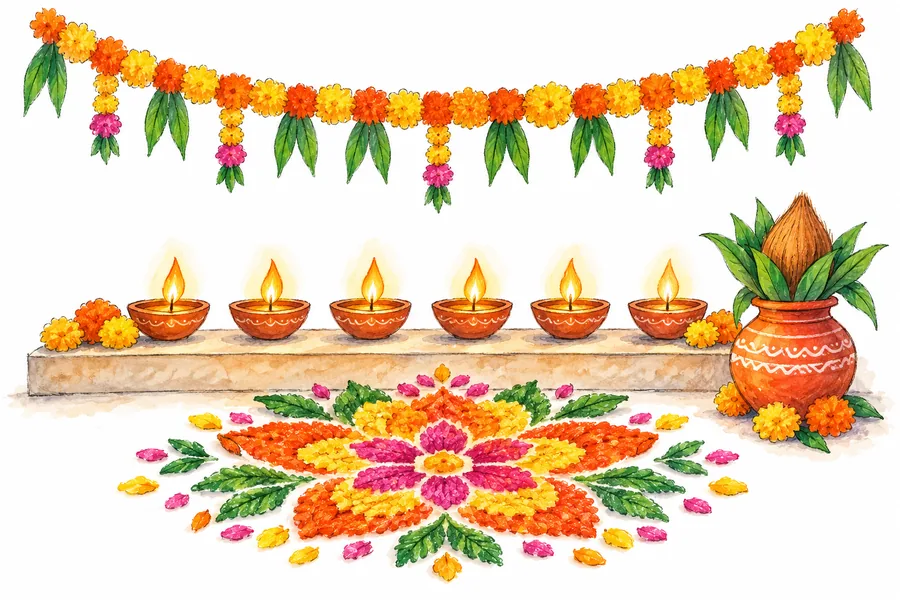
The Rakhi ceremony is ideally performed during the aparahna kala — the afternoon period — though morning hours after sunrise are also acceptable. The family assembles with a pooja thali that holds a lit diya (lamp), kumkum, rice grains (akshata), yellow turmeric paste, sweets, and the rakhi. The sister first applies a tilak of kumkum and turmeric on her brother's forehead, then touches a few grains of rice to the tilak while reciting the traditional raksha mantra: Yena baddho Balee raajaa daanavendro mahaabalah, tena twaam anubadhnami raksha me chalacalaa — a verse from the Vishnu Purana invoking the binding of the demon king Bali as a protective precedent. She then ties the rakhi on the brother's right wrist and waves the lamp in a clockwise aarti motion. The brother gives a gift — traditionally of his own choosing, representing his personal commitment to her. In many families, the brother also ties a protective thread on the sister's wrist, completing the mutual covenant. The ceremony should ideally conclude before the Bhadra period (an inauspicious time governed by Saturn's shadow) passes into Purnima. Consulting a Panchang for the precise Bhadra-free window is strongly advised.
Regional Variations and Modern Rakhi Traditions
In Rajasthan, Raksha Bandhan is called Ramri Teej and is combined with the worship of the goddess Jhulelal. Women tie rakhis not only on brothers but also on trees, rivers, and sacred places as acts of cosmic protection. In Maharashtra and coastal regions, the festival coincides with Narali Purnima — the coconut full moon — when fishing communities offer coconuts to the sea god Varuna and begin the post-monsoon fishing season. Here the rakhi tradition and the sea offering are performed on the same day. In West Bengal, this day is observed as Jhulana Purnima, associated with Lord Krishna's swing festival, and the rakhi dimension is overlaid with devotional singing. In South India, particularly among Tamil Brahmin communities, this day is observed as Upakarma, or Avani Avittam — the sacred thread renewal ceremony when Brahmin men change their sacred thread (yajnopavita) and recite Vedic hymns as a form of annual spiritual reset. In contemporary urban India, the festival has expanded beyond blood siblings to include rakhi tied to friends, colleagues, and mentors — evolving the original covenant from biological to intentional community. Rakhi workshops, eco-friendly seed-rakhis, and rakhi deliveries to soldiers at the border have all become part of a living tradition.
Astrological and Tithi Connection
Raksha Bandhan falls on Shravana Purnima — the full moon of the month of Shravana (Sawan), which typically coincides with the sun in Simha (Leo) and the moon in the nakshatra Shravana. This nakshatra, ruled by the moon and presided over by Vishnu, carries the energy of attentive listening and sacred vows. The Purnima itself is astrologically significant: the moon is at its fullest power, tides are at their peak, and the subtle body of humans is considered most responsive to emotional and devotional impressions. Timing the rakhi ceremony correctly is considered essential — the Bhadra Kala, ruled by Bhadra (a malefic daughter of Surya), occurs during a specific portion of the Purnima tithi and is considered highly inauspicious for any auspicious activity, including tying the rakhi. Scriptures explicitly warn against tying the rakhi during Bhadra. The exact Bhadra period varies each year based on the Panchang calculation, and families in traditional communities wait until Bhadra passes before beginning the ceremony. Astrologically, the combination of Shravana nakshatra with a full moon creates what is known as a Vishnu Yoga, making any protective sankalpa initiated at this time especially durable and blessed.
 Festival