Vedic Astrology
What is Kundli?
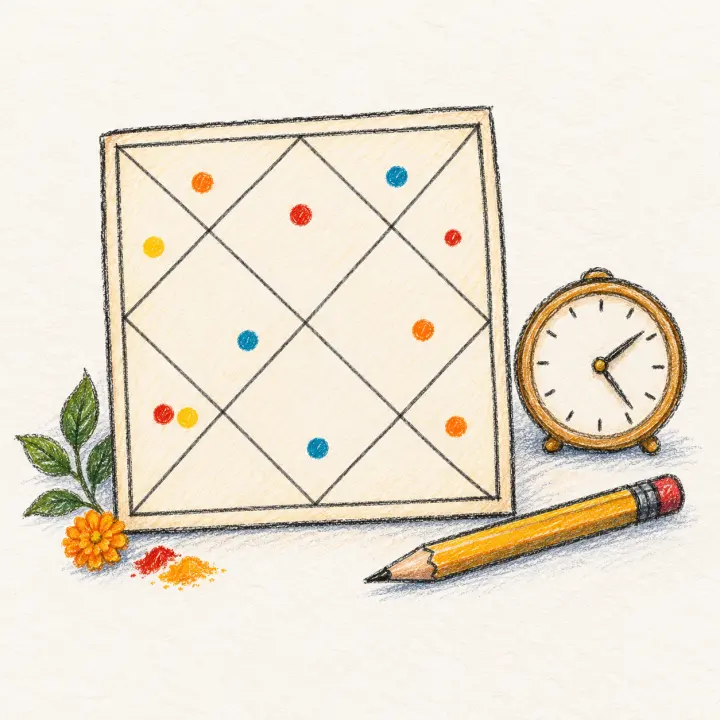
A kundli is the Vedic birth chart — a snapshot of the sky at the exact moment and place you were born. It maps the nine planets across the twelve houses, encodes your life patterns, and powers every other Vedic astrology tool on this site.
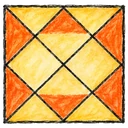
Rāśi ChartNorth Indian diamond. Cast yours from birth details.
What does kundli mean?
Kundli (also called janam-kundli or birth chart) is a two-dimensional map of the sky at the exact moment and place you were born. Vedic astrology uses this map to describe the patterns that shape your life. The word itself comes from Sanskrit: kund (a bowl or pit) and li (the grid lines drawn inside it).
What a kundli shows you
Three things matter in every kundli: the twelve houses (bhavas) representing life domains, the nine grahas (planets — Sun, Moon, Mars, Mercury, Jupiter, Venus, Saturn, Rahu, Ketu) placed in those houses, and the ascendant (lagna) — the sign rising on the eastern horizon at your birth moment. Together they encode personality, relationships, career, wealth, health and the long arc of your life.
How a kundli is cast
To cast a kundli you need three things: your date of birth, your exact time of birth (the more precise, the better — even a few minutes shifts the ascendant), and the city where you were born. Healers World uses Lahiri ayanamsa, the official ayanamsa used by the Government of India's calendar reform committee. Our calculation runs against the same astronomical ephemeris that India's most established astrologers use.

What makes a kundli Vedic (not Western)
Vedic kundli uses the sidereal zodiac, anchored to the actual constellations — not the moving tropical zodiac used by Western horoscopes. This is why Vedic horoscopes read by Moon sign (Rashi) and Western horoscopes by Sun sign: the two systems disagree on where the zodiac starts, and over 2,000 years of precession has shifted them by about 24 degrees.
What you can do with your kundli
Your kundli powers the rest of Vedic astrology: daily horoscope by Moon sign, kundli matching for marriage, dasha timing for major life events, dosha detection (Manglik, Kaal Sarp, Pitra), yoga analysis (Gaj Kesari, Raj Yoga, Panch Mahapurusha), and personalised remedies. Every tool on this site starts from the same kundli you cast once.
Cast your kundli — free, no signup
Healers World lets you cast your kundli in under a minute, without creating an account. You get the rasi chart, navamsa, current dasha, major yogas and a one-page summary. Upgrade to a paid reading for the deep dasha timeline, complete remedy list, and a printable PDF report — but the chart itself never costs anything.

Frequently asked
Is kundli the same as horoscope?
Kundli and horoscope are related but different. A kundli is the full birth chart — a map of all houses, planets and their relationships. A horoscope is a reading or prediction based on that chart (or on the current planetary positions). The kundli is the source; horoscopes are interpretations.
Can I cast a kundli without exact birth time?
You can, but the ascendant (rising sign) and house positions will be approximations. The Moon's nakshatra and the dashas are usually recoverable even with an approximate time. Many families in India preserve the exact birth time down to the minute — it is worth asking older relatives before you assume you do not have it.
Which ayanamsa does Healers World use?

Lahiri ayanamsa, the official Indian government standard since 1956. This matches the ephemeris used by India's Council of Scientific and Industrial Research, by major temple publications, and by most practising Vedic astrologers in India today.
Is the free kundli accurate enough for matching?
Yes. The free chart uses the same ayanamsa and the same planetary positions as the paid reading. What the paid reading adds is the interpretive layer — detailed dasha timelines, yoga explanations, dosha remedies and a formatted PDF report. The chart itself is identical.
What is the difference between rasi chart and navamsa?
The rasi chart (D-1) is the main birth chart — planets placed in the 12 zodiac signs. The navamsa (D-9) is a finer-grained divisional chart, each sign divided into nine parts of 3°20′ each. The navamsa refines rasi placements and is especially important for marriage matching and dasha interpretation.
Cast your kundli in under a minute
Free, no signup. Lahiri ayanamsa, real ephemeris, ten languages.