 Healers World












































What does Sawan Somvar mean for your practice?
Sawan Somvar is the Monday observance of Shiva devotion during Shravan, also called Sawan. Devotees may offer worship, hear the katha and keep a fast suited to their household practice. Shravan's dates differ between regional lunar calendars, so check your local panchang rather than copying another region's schedule, and keep fasting compatible with your health and medication.
Why is this observance important?
Shravan is considered Lord Shiva's most sacred month, and every Monday within it is kept as a fast day in his honour — the single most widely observed recurring Shiva-vrat of the year, drawing enormous temple crowds and the Kanwar Yatra pilgrimage.
Which story is remembered?
Shravan's sanctity for Shiva devotees is most often traced to the Samudra Manthan, the churning of the cosmic ocean, in which Shiva drank the world-threatening poison that emerged to protect all beings; the month is kept as a season of gratitude and worship in response, with Monday — Shiva's own day of the week — observed most intensively of all.
When is it observed?
Every Monday that falls within the lunar month of Shravan (Sawan) — typically four or five Mondays across the month. Reckoned from the panchang each year, since the month's start and length shift slightly year to year.
How is it observed in the tradition?
- Fasting each Monday of Shravan, commonly until evening, with a single grain-free meal
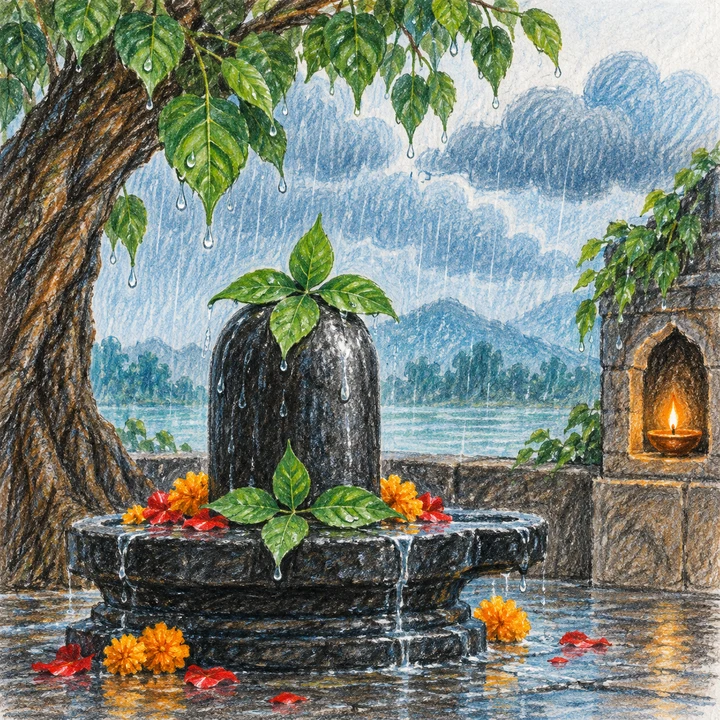
- Shiva linga abhishekam with Ganga water, milk, honey, and bael leaves
- The Kanwar Yatra — pilgrims (Kanwariyas) carrying Ganga water on foot to offer at a Shiva temple
- Chanting 'Om Namah Shivaya' and reading the Shiv Chalisa through the month
How do household and regional customs differ?
Observed across nearly all of Hindu India, with North India's Kanwar Yatra — lakhs of saffron-clad pilgrims walking to the Ganga and back to their local Shiva temple — as its most visible large-scale expression; South India keeps the month with equally devoted but quieter temple worship.