 Healers World












































What does Vat Savitri Vrat mean for your practice?
Vat Savitri Vrat remembers Savitri's devoted resolve and her prayer for Satyavan's life, with worship associated with the banyan tree. The observance and lunar date differ between regional traditions, including Amavasya and Purnima practices. Follow the katha and rite taught in your household, confirm the applicable panchang rule, and adapt fasting to your health and capacity.
Why is this observance important?
Vat Savitri is kept by married women praying for their husband's long life and wellbeing, and by some as a prayer for a good marriage. The banyan (vat) tree is worshipped as the site of the vrat's founding legend and for its own long lifespan, a symbol devotees pray to share with their marriage.
Which story is remembered?
The Mahabharata's Vana Parva tells of Savitri, who married Satyavan knowing a sage had foretold his death within the year. When Yama, the god of death, came to take Satyavan's soul under a banyan tree, Savitri followed him on his return journey, answering his questions on dharma so wisely that Yama granted her boons — ultimately, without naming Satyavan directly, a boon of sons that could only be granted if Satyavan lived. Yama honoured his word and restored Satyavan's life.
When is it observed?
In North India, the Amavasya (new moon) of the month of Jyeshtha; in Maharashtra and parts of South India, the same observance is kept instead on Jyeshtha Purnima (full moon), a fortnight apart, as Vat Purnima Vrat. Reckoned from the panchang each year.
How is it observed in the tradition?
- Fasting, often nirjala (waterless) in the stricter observance, from sunrise
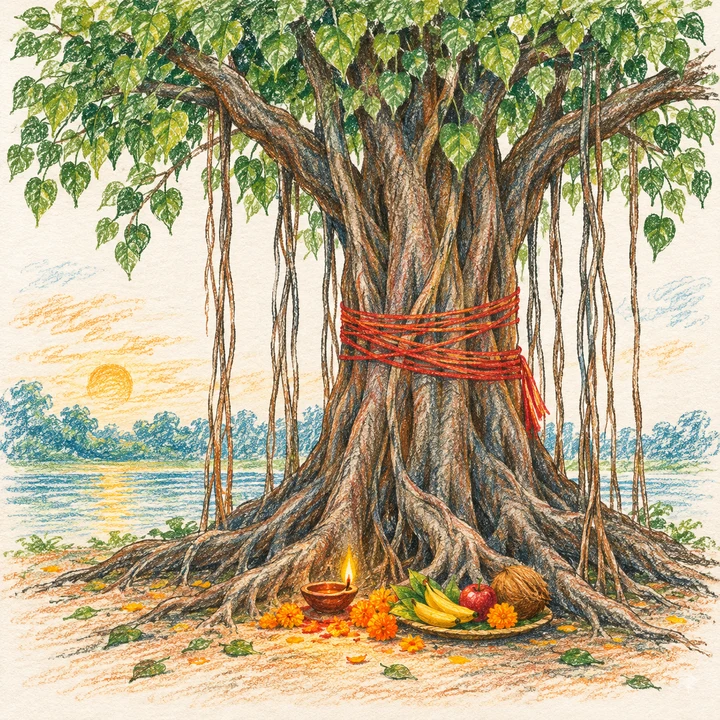
- Worshipping a banyan tree — tying a sacred thread (raksha sutra) around its trunk while circumambulating it
- Offering flowers, fruit, and vermilion (sindoor) to the tree and reciting the story of Savitri and Satyavan
- Dressing as a new bride in some regions, wearing the solah shringar (sixteen adornments)
How do household and regional customs differ?
Kept as Vat Savitri Vrat on Jyeshtha Amavasya across North India (Uttar Pradesh, Bihar, Rajasthan, Madhya Pradesh), and as Vat Purnima Vrat a fortnight later, on Jyeshtha Purnima, in Maharashtra and Goa — the ritual core (banyan-tree worship, the Savitri-Satyavan story) is identical; only the tithi and the local name differ.